

Abercrombie Township, Quebec

Placenames are among our most enduring records and should be maintained in some form, even if the person or thing honoured has lost our respect or the people who chose it have been pushed away. There was a reason to choose it when it was selected and future generations deserve to know.
The Township of Abercrombie encompasses the municipalities of Ste. Adele, Ste. Marguerite Station and Mont Rolland. Touching both St. Hippolyte and Shawbridge (now part of Prévost), it was originally named to commemorate General James Abercromby. Exactly why he should have been so honoured is a bit of a mystery. It could be simply someone’s sense of humour, an encrypted message to the future inviting us to look back and see that men credited as being among the victors in war are not always winners.
Abercromby, who spelled his name with a ‘y,’ as found on some older maps, was one of the slew of British generals who played their parts during the Seven Years’ War from 1756 to 1763, considered by some historians as the first global conflict. One of the sparks that exploded into combustion was friction between the French and the English in the Ohio Valley when a young George Washington, interloping in French territory, surprised a French party under the command of the Sieur de Jumonville. Jumonville had been sent from Fort Du Quesne to admonish Washington for violating the Peace Treaty of Aix-la-Chapelle (Aachen 1748). When Washington’s men saw the surprised French going for their guns, Jumonville managed to make his presence felt and bring a calm over the confrontation. Through his translator, he successfully communicated that he and his party were messengers for the French authorities, and then he began to read a proclamation. As his translator repeated it in English, a member of the English party, a Seneca chieftain remembered as Half-King, shot Jumonville in the head at point-blank range. This was followed by the assassination of nine other members of the French party and the rest, except for one, were taken prisoner.
The sole escapee returned to Fort Du Quesne, and the French responded by overwhelming Washington at his hastily erected Fort Necessity and serving him with a humiliating defeat, allowing him and his men to return to British territory unarmed and on foot. The humiliation cannot be overstated because the Indigenous Nations in the Ohio Valley were crucial allies to both European powers, and they, lacking any other means of evaluating these two sets of warring Whites, tended to back the stronger side. In fact, Half-King had been wooed by the French but had adjudged the English to be a stronger force. While he had been let into the French confidence and knew, according to the French, that Jumonville’s was not a war party, he seems to have concluded either that the French desire for peace and discussion was a sign of weakness or that it was in the interest of his own people for the French and English to fight. As a result, after advising the French of Washington’s presence, he led Washington to the small French party coming to advise them they were on French-claimed territory, instigating confrontation. His action helped start the largest global war that the world had yet seen, but he was equally disappointed in both parties after the French overwhelmed Fort Necessity and then let their captives go.
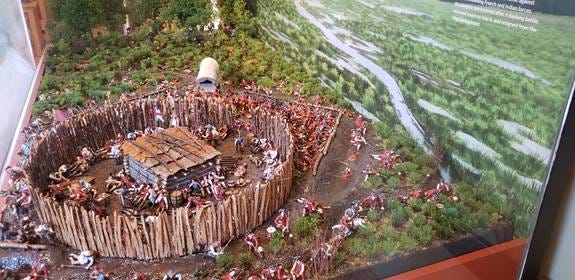
This remote skirmish inflated into a world conflict when the British Crown decided to retaliate. Even though they had been at peace since the signing of the Treaty of Aix-la-Chapelle, they were trade rivals who were incapable of sharing territory. Their differences were not limited to the Ohio Valley, but France was England’s major rival for a worldwide commercial empire, and the ensuing war would be one of European, and thus world, hegemony, the beginning of the English world hegemony that we lived with until the 1940s. The first objective of the British was to eliminate French naval power. The adversaries, who rapidly lined up against each other, were the British, Prussians and Hanoverians against the French, Austrians, Swedish, Saxons, Russians and eventually the Spanish. General Abercromby, who had achieved his status through political connections and had little field experience, was dispatched to oversee the English military operations in the colonies. The French sent more troops under the command of General Montcalm.
One of the first objectives of the English was to capture Fort Carillon (Fort Ticonderoga) situated at the southern end of Lake Champlain. Abercromby, appointed at the request of King George II, was told to rely on one of his most experienced generals, George Howe, to plan and execute the attack. Montcalm, the defender, had 4000 troops; Howe had 15,000. They would have to travel up Lake George and then along five miles of river and portages to Lake Champlain. Along the river they could easily root out the advance parties and capture the small settlements of the French. The first confrontation was with troops trying to return to Fort Carillon. In the ensuing skirmish, Howe was killed.
The death of this crucial leader left Abercromby at a loss for what to do. He dallied so long that his troops nicknamed him Mrs. Nambie-Crombie. By the time he finally resumed the advance, Montcalm had had ample time to receive reinforcements and surround Fort Carillon with barriers of brush and fallen trees. Abercromby ordered the storming of these barricades but neglected to use his superior artillery. As the battle progressed, the British troops were bogged down and slaughtered, and when the dust settled, they had lost 2000 men and were forced to retreat. The French losses were 350 killed and wounded. Abercromby, overwrought and panic-stricken, ordered a retreat and withdrew, not only along the five miles of portages that they had captured, but to the far end of Lake George.
When word of the catastrophe got back to England, Abercromby was recalled and General Jeffrey Amherst, named by the British-Huguenot general Jean-Louis Ligonier, was sent out in his place. Amherst would successfully push all the way to Montreal, taking it in 1760, the year after Wolfe, also endorsed by Ligonier, had taken Quebec City.
Abercromby found himself a safe seat in Parliament from which he became a staunch supporter of the Stamp Tax and opponent of any opinion that favoured the colonists in their bid for independence. The Cantons du nord (Northern Townships) were created to encourage the Canadiens to stay with the British in the early 1800s rather than leave for the new American republic that Ambercromby had so viscerally opposed. This township still carries his name, but today, only notaries and surveyors seeking to confirm chains of title in that early township will see it in old forgotten archives as a goading reminder of a loser in the roster of Great Britain’s victorious generals of the Seven Years’ War.