


There are stories behind the names of places that tie us back into our history. Some places are connected in ways that are no longer obvious. Here are two such places.
The family-name Brant first came into our historical records in 1753, when Colonel William Johnson attended a Militia Day event in New York. He came across his friend Nickus Brant, a Dutch-Mohawk trader, among the spectators. Brant was accompanying a recent widow and her children, all returning from Ohio and they were watching a horse race between British officers and Mohawk riders when one of the officers challenged Margaret’s daughter Molly to take his horse into the race. When Johnson saw Molly leap gracefully onto the horse, he was stricken with love, beginning an epic period of American colonial history.
William Johnson was an Irishman sent off to the colonies by his uncle after he was expelled from college. His uncle, Peter Warren, had married into the Huguenot-Dutch De Lancy family where Johnson found fun-loving kindred spirits. Soon, though, he moved out on his own, setting up a farm in the Mohawk Valley. An independent attitude caused him to be shunned by Albany society, and he rapidly became more connected to the Mohawk (Kanien’kehà:ka). He learned the language, wrestled with the young men and generally added to his alienation from Albany, but his business skills helped him establish a strong brand, trading with both the people of Albany and the Mohawk with equal ease and fairness. His relationship with Molly Brant, whose Mohawk name was Konwatsi’tsiaiénni, became the last straw, but they still needed him for his skills and trade. Johnson and Brant would become a power couple easily bridging the divide, with Molly’s status rising in her culture as quickly as Johnson’s was being sullied in his.
The Mohawk were the face, the Eastern Door, of the Six (originally five) Nations of the Haudenosaunee, the ones who first met the Dutch and English, and were a power to be reckoned with, but the colonial leaders failed to gain the respect that the Dutch had earned a century before them. During those same years their differences became insurmountable, and the Six Nations broke their long-standing relationship, called the Covenant Chain, putting them effectively in a state of war.
The British Crown could see that it would be just a matter of time before the powerful Six Nations would ally themselves with the French. Action had to be taken immediately. The British named Johnson Superintendent of Northern Indian Affairs, reporting directly to Great Britain, and the Mohawk accepted him as their ambassador to the British, both bypassing the governors.
The Covenant Chain was repaired, the status of the power couple grew and Johnson took on Molly Brant’s younger brother Joseph (Thayendanegea) as a protégé, seeing to his education in both Indigenous and British ways. Soon, Johnson’s military prowess became an essential tool for the British as they found themselves at war with France.
The Seven Years’ War was a European war of hegemony principally between these two powers. Johnson was a local actor, the person who saw what had to be done on the ground. He and his allies played a military role, and they advised the Seven Fires of Canada to stay neutral. The Seven Fires, small forces compared to the Six Nations, were allied with the French and had to rapidly understand how to protect themselves from a war that was vastly larger than them. When the French called them to a strategy meeting to defend Fort Île-aux-Noix at the south end of the Richelieu River, they made two conditions, that the French supply 5000 troops and that they be given time to assess the strength of the advancing army. In the world context, New France was simply not important enough to send that many troops, so the Seven Fires chose neutrality over the option of becoming cannon fodder.
After the war, Johnson and Brant were faced with a difficult peace. Without the French, the real enemy of the Six Nations became fully evident – it was not just the Thirteen Colonies, it was the vacuum left behind by the French, leaving the British to feel that they no longer needed the Indigenous people. General Amherst made the transfer to governance poorly, proving himself incapable of dealing with the disillusioned Indigenous allies and he stooped to trying to poison his opponents in the Pontiac uprising. Johnson and Brant managed to get Great Britain to issue the Proclamation of 1763, establishing a western border to the 13 Colonies, and Johnson took over negotiations with Pontiac. Through the 1760s, though, the exploding population of the 13 Colonies became increasingly difficult to contain. In 1768 they established a new border conceding a large parcel to the colonists and did so under pressure, neglecting to consult properly with the Indigenous Nations that would be affected.
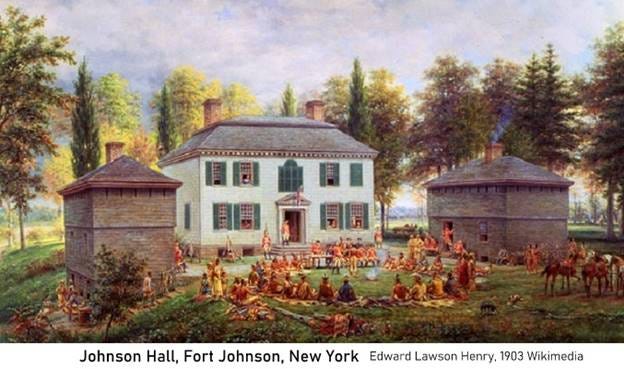
In early July 1774, 600 Six Nations leaders gathered with Johnson and Brant at Johnson Hall (called Fort Johnson today), the always open home of the Johnsons. They were there to discuss how to deal with the collapsing border, but following the protocol of the Six Nations, it would be fully five days before Johnson’s turn to address them came. This was a system he knew and had experienced before, and he talked for hours in the hot sun on the afternoon of July 11. The body language was as expressive as the voice, and as he finished he had spasms and was led to his room to lie down. Joseph Brant was with him and he said, “Joseph, control thy people. I am going away.” Two hours later, those gathered in vigil in the late afternoon heard Molly raise her voice in the death wail of her tradition. Johnson’s death would mark the beginning of the end. Britain was exhausted financially at the end of the Seven Years’ War. A tax on tea to help it deal with flooding in what today is Bangladesh gave the colonial elite an opportunity to stage a tax revolt in Boston, manipulating their citizens. Their issues included the right of French Canada to maintain its Catholic religion, and the border that the Proclamation had created.
Five of the Six Nations remained allies of the British. The sixth, the Oneida, who were still buffered by the remaining Mohawk land, felt they could negotiate with the monster that crossed the Proclamation border.
The Seneca, the largest Nation, also known as the Western Door, comprised fully half of the Haudenosaunee population and was the furthest away; their villages and fields were still intact. The rebels, moving west, found their huge fields and villages and set fire to everything, including food stocks. They would never forget the quality of the land they had burned.
When the British king, George III, sued for peace, the rebels agreed to meet in Paris. The original peace agreement involved the recognition of a buffer state where the Indigenous Nations would be respected, but the American negotiator John Jay felt he could do better. He met separately with the British prime minister, the Earl of Shelburne, who sought to promote trade with the new nation. Shelburne conceded all the land to the west as far as the Mississippi River. The Haudenosaunee allies were not even invited to the treaty as their land was simply given away. Even Joseph Brant and the British military in the colonies that would become Canada were not consulted or informed until after the fact.
The Haudenosaunee are comprised of six Nations who saw William Johnson as their ambassador. Indigenous peoples lived on the land. They did not have the concept of ownership of land as the Europeans did. In 1763, the British had taken the land that the French had until then claimed and the Indigenous Nations living on it could stay there by their good grace. William Johnson was the superintendent of northern Indian affairs. His role was to protect the interests of the king. Molly and Joseph Brant grew up with a totally different understanding. This is the crux of the problem that reconciliation is supposed to deal with—it is the difference between a market economy and a gift culture. Your currency in the gift culture is the goodwill that you invest in others, the trees, the animals, the waterways and the spirits are all members of the family. In hard times and in good times, you share. This gift culture is not a recent invention. You will find it among Indigenous cultures the world over. It has existed in some form in the Americas since before the Pyramids of Egypt were built and in all that time, weaponry was not developed as it was in the market economy and the religious traditional cultures of Europe and Asia. That does not mean they did not have wars – of course they did, but they were never the norm.
At the time of the creation of the United States, when this was all playing out, the governor of the remaining British colonies that we now call Quebec and Ontario was Sir Frederick Haldimand, who voiced his reaction: “My soul is completely bowed down with grief.” Like all of the British military and many of the colonists, they were in shock, especially when the prime minister of Britain, Lord Shelburne, explained his reasoning: “The Indian nations were not abandoned to their enemies; they were remitted to the care of neighbours… who were certainly the best qualified for softening and humanizing their
hearts.”
Within his powers, Sir Frederick Haldimand tried to address the disastrous situation. He created the Haldimand Tract, a parcel of land “…situated between the Lakes Ontario, Erie and Huron and I do hereby in His Majesty’s name authorize and permit the said Mohawk Nation and such others of the Five Nation Indians as wish to settle in that quarter to take possession of and settle upon the Banks of the River commonly called Ours [Ouse] or Grand River, running into Lake Erie, allotting to them for that purpose six miles deep from each side of the river beginning at Lake Erie and extending in that proportion to the head of the said river, which them and their posterity are to enjoy for ever.”
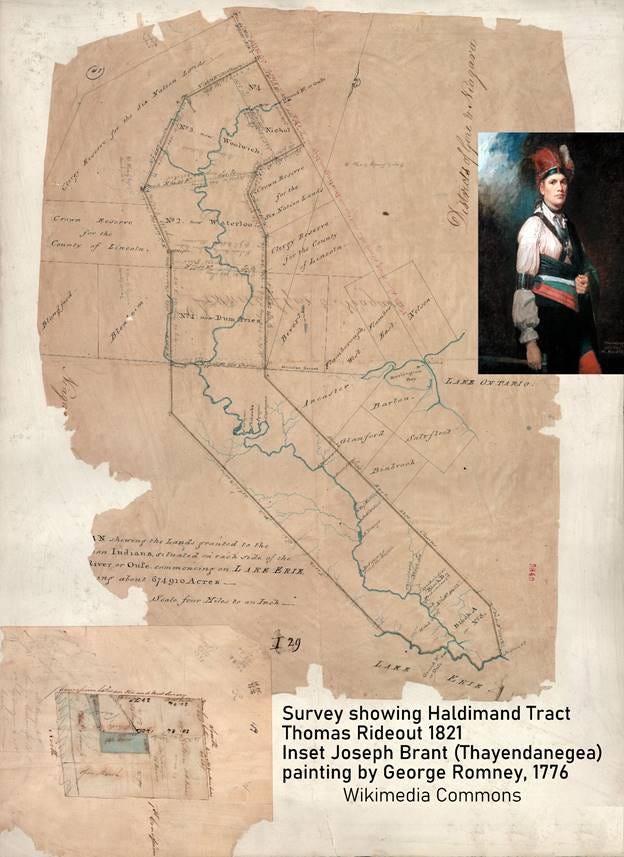
Joseph Brant knew this land and had influence on its choice. He had even created a ford to cross the Grand River, which came to be called Brant’s Ford, and eventually Brantford. The British colonial governments, though, did not honour Haldimand’s pledge and over time governments have whittled it down to less than five percent of the original commitment. Brantford, Waterloo and Kitchener are all located in the original tract area that was once recognized and then taken away.
Molly Brant had remained a stalwart supporter of the Mohawk cause, acting as a spy for the British during the balance of the war. She was obliged to flee and eventually moved to Kingston, near two of their daughters, where the British supplied her with a house and a pension. She also received a good settlement from the distribution of her husband’s estate.
Wow…a fascinating…and sad chapter in our history. Thanks again Joe.b