


We imagine we have something to do with the choice, but the thing being named has its say.
Reverend Théophile Thibodeau was not a typical priest. He assumed responsibility for the parish of Ste. Agathe des Monts in 1878 and, while he was loved and respected in his parish and is credited with the colonisation of Archambault township and the construction of a chapel, his real passion was his homestead. It consisted of a large portion of a peninsula in Ste. Agathe’s Lac des Sables known today as Greenshields Point. Four years after assuming his parish responsibilities, he managed to resign and to move to his homestead.
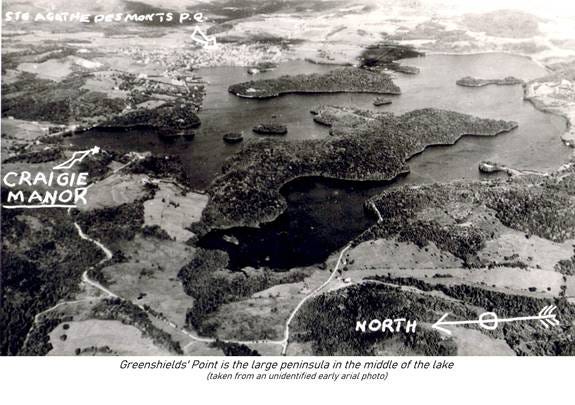
His parishioners were not ready to let him off that easily, however, and some years later he succumbed and accepted the responsibility of parish priest. He assumed the mantle of spiritual leader on time to establish himself and be there for Ste. Agathe’s bleakest period, 1885 to 1888. A man who appreciated his comforts, he had just raised enough money to have a more suitable presbytery built, and it was from this new building that he guided his flock through a year of a plague of smallpox. While a vaccine had been developed and even administered years before, the Catholic community of Montreal, and therefore of most of Quebec, feared that the vaccine was a plot to destroy the French and discouraged vaccinations. The result was a plague that ran rampant through the city and outlying communities, forcing the whole region to be quarantined. In the small village of Ste. Agathe, fifty people died from it. Following hard on the plague, the region experienced three years of drought so severe that by the end, farmers’ seed stocks were gone and many farmers simply left. Finally on April 9, 1888, the new presbytery caught fire and the good parish priest lost his life trying to save the building. Some residents of Greenshields Point still remember being told the story of how the wind whistling through the trees on the point is the song of the departed parish priest.
In 1893, Octavien Rolland, son of Jean-Baptiste Rolland, founder of Rolland Paper, acquired the point from the estate of the parish priest. The Rollands built there and were among the very first people to acquire a vacation property in Ste. Agathe. As a private owner, his 20-year stewardship was longer than the parish priest’s and one year longer than that of the Greenshields family, who acquired it from him in 1913. By that time, it was called Rolland’s Point and, given the importance of Rolland’s family across the Laurentians, it is strange that it began to be called Greenshields Point.
The peninsula consisted of 80 to 100 acres of land under a canopy of white pines, with over 12,000 feet of lake frontage. At the time, many wealthy, influential people had acquired property on Lac des Sables and had built large, impressive country villas. There is no remaining evidence of any such building being undertaken by James Greenshields, One reason given for his acquisition was to occupy his son while he took the cure for tuberculosis at the Laurentian Sanitarium. The son built a golf course under the white pine canopy, but it was not a commercial or public enterprise. Yet it remained Greenshields Point. The Greenshields family held the property for 19 years until 1932 and eventually sold it to developers under the name of the Mitawanga Company.
Once the redevelopment was completed, the Mitawanga Association of property owners replaced the Mitawanga Company, but ninety-four years later people still refer to it as Greenshields Point.
James Naismith Greenshields was born in Danville, Quebec on August 7, 1852. He studied law and was called to the bar in 1877. He was hired as the third lawyer in the defence of Louis Riel in 1885. According to George Goulet, author of The Trial of Louis Riel, the defence team of Fitzpatrick, Lemieux and Greenshields began by vigorously challenging the authority of Magistrate Richardson, and when their challenge was summarily dismissed, they proposed a plea of insanity, a decision that was opposed by their client. They attributed their decision to information obtained from certain undisclosed parties and most likely were referring to Riel’s period of confinement in two insane asylums in Quebec from 1876 to 1878. In spite of his involvement in this high-profile case, Greenshields turned to commercial and corporate legal matters. This brought him to be involved in Shawinigan Water and Power and Wabasso Cottons. He encouraged two of his sons in the creation of Greenshields & Company, later Greenshields Incorporated, and subsequently Richardson Greenshields. It is a curious circle that brings names together this way. While the Richardson name relates to a Winnipeg entrepreneur, there seems to have been no connection between him and Magistrate Richardson of the Riel trial, except to the extent that Greenshields had also been involved with that Richardson. One of Greenshields’ sons died during the First World War and a second died later, presumably of tuberculosis. The third became the owner of Greenshields Point who sold it in 1932.
Locally, so few people know the history of the Greenshields family that it is hard to understand how the name survived. In 1998, a member of our heritage committee, Erik Wang, a resident of Greenshields Point, sent a letter to the Quebec Commission de toponymie hoping to find the meaning of the word the developers had used, Mitawanga, and he discovered from them that Mitawanga came from the Algonquin word Mitanhwang, meaning “on the sand” or “sandy shore.” They even implied that it would be a more colorful name for the peninsula than Greenshield (sic), a name that seemed without foundation.
Wang, diplomat that he was, thanked them and shared the colorful role of James Greenshields in the defence of Louis Riel, and encouraged them to standardize the spelling to Greenshields Point. The Commission de toponymie was in the process of updating the placenames of Ste. Agathe and obliged him.
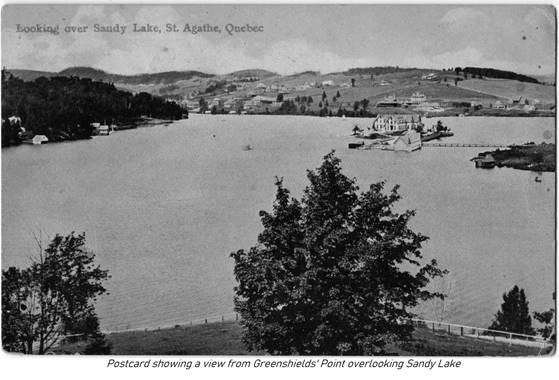
The name became more permanent, but many of us wondered about the discovery and usage of the name Mitawanga. Did the developers know that the name they had chosen may have been the source of the name of the lake itself, Lac des Sables, or as it was also called back then, Sandy Lake? Is it possible that some Algonquin terms were familiar at that time? Could there have been a familiar presence of Algonquian – Weskarinis people who were simply not recorded any other way?
I wonder… how much more reverence I’d have had, if the history of our place was alive in us back in the day. Thanks for this.
iA Greenshields family has been part of our community for a few generations. At least one family lived in our place at 292 Sennevilled Rd. meaning that he was likely the Bois de la Roche farm manager at the time, I met at least one of them, a distinguished tall and elegant older woman, at New Years celebrations with Jim Shea's family at 294 in the 1990s. A couple of years ago a younger relative came to the door asking about a box with John (?) Greenshields on a card stapled to the back. It is an old barnwood empty crate that is likely still in our attic. Nothing interesting except that the name was there and was my hint that Greenshields was yet another name attached to this much lived-in house.