


O wad some Power the giftie gie us
To see oursels as ithers see us!
The choice in the subtitle relates to two different perspectives on being. The first comes from the Darwinian concept of the survival of the fittest, a term Charles Darwin adopted from one of his readers and fellow theorist Herbert Spencer, who encouraged Darwin to use it instead of Darwin’s term, natural selection.
Darwin observed that circumstances could be subject to change while Spencer saw humans as being instrumental in their survival. Simply put, in Spencer’s definition the fittest species is the most numerous one, proving its fitness by having taken over territorial resources. In his book The Man Versus the State, Spencer summarized the term in this statement: “Thus by survival of the fittest, the militant type of society becomes characterized by profound confidence in the governing power, joined with a loyalty causing submission to it in all matters whatever.” The military terminology was a proper reflection of the times. Young men grew up and served in the military, reinforcing the gender status and thereby showing the dominant role of mankind. His thinking led to the idea of man as an apex predator through individual submission to military power, but unpacking it, all species are instrumental in their own survival.
Darwin had not intended Spencer’s interpretation. His theory showed changes were a result of natural mechanisms. Things changed because circumstances changed. He was not describing humanity’s role as a privileged super-species even if he saw humanity in some similar way. He was not specifically excluding humanity from nature either. His theory was based on scientific observations.
From personal experience living on the land for half a century, growing our own food and dealing with our neighbouring species, I have come to learn that predators come in many forms, from tiny species like lice, black flies and mosquitoes to larger carnivores. I tend to see the insect varieties as the only mindless predators, as Robert Burns described it in To a Louse. But I am trying, still, to see them more generously. The carnivores, the ones that we can understand better and that Spencer might have classified as lesser predators, are of a different order. First of all, they are easier to communicate with. Their language is chemical and they are polite and follow rules. I flatter myself into thinking that we occupy a definable space among them. By the understanding of our modern legal system, we occupy 73 acres, about one acre of which is under intensive use, but the rest is the home of many carnivores who pass through on their specific routes. I learned to respect their calling cards – distinct and no-nonsense deposits asking for permission to occupy. The coyote is clear because its droppings contain fur, but even the smallest members of the weasel families ask permission. If they are small, their presentation might be just to show themselves. A part of my education came through a visit to my chicken coop years ago. There were seven hens inside and their yard was fenced with one-inch square welded wire mesh four feet high. They were locked protectively inside the coop at night, and the ventilation openings were also covered with the same mesh. For something to get in, I reasoned, it would have to squeeze through a one-inch-square hole, something small enough to not pose a threat to the chickens. Over a number of days, the cutest little creature greeted me morning and night. I thought it seemed as harmless as a chipmunk.
In retrospect, it was probably a creature called the least weasel. One morning, upon opening the coop, I found all seven chickens dead, their necks bitten – for the blood? I do not know, but I learned that there was a predator that could squeeze through a one-inch hole. Unlike a louse, though, it did ask for permission to enter. I had only my ignorance to blame, but over the decades we gathered many stories of encounters with our neighbours as we slowly learned our way of living and sharing in the woods.
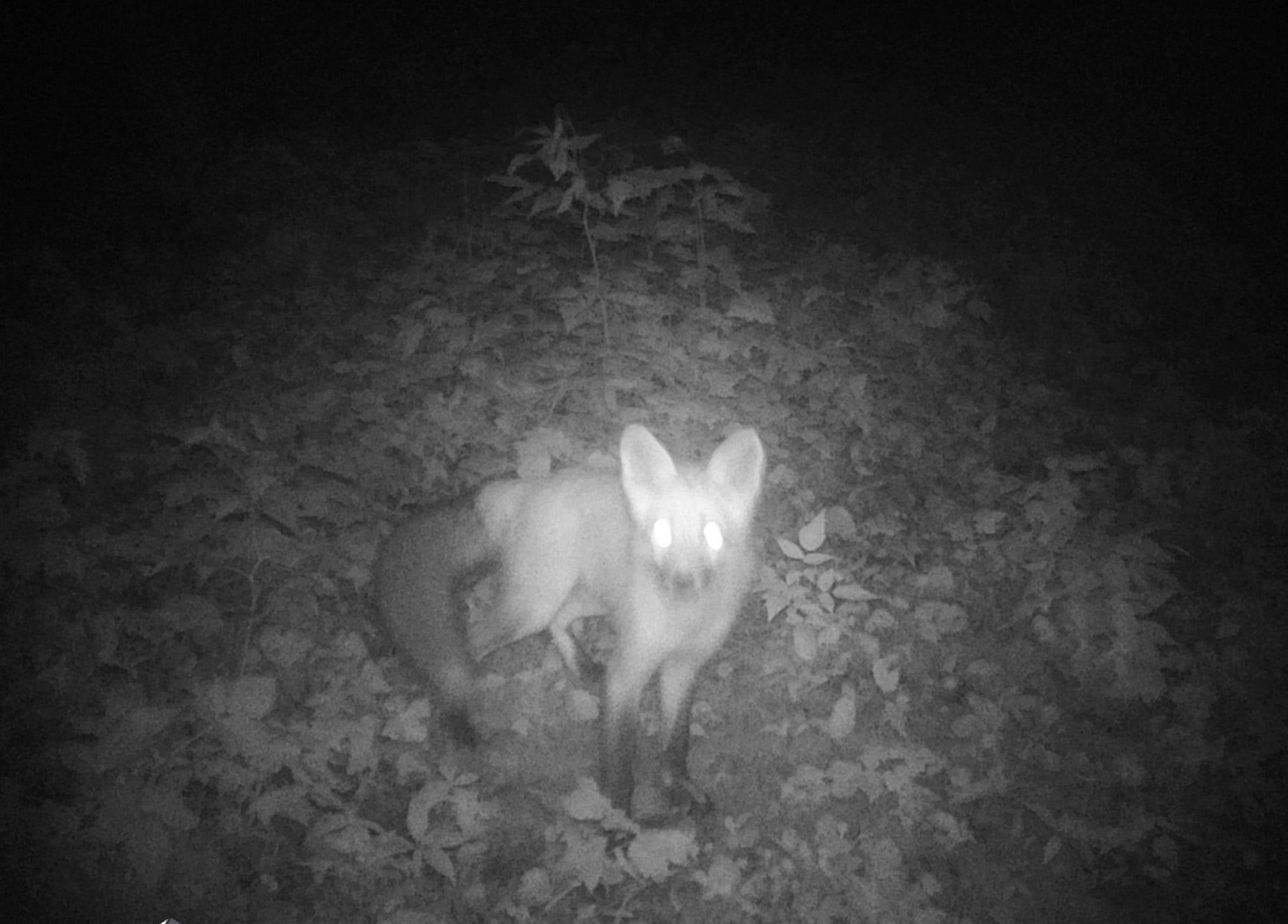
Lice, mosquitoes, black flies and other insect species are apex predators. They do not seek permission. When the American Executive describes their role as Apex Predator, I see them as having stepped way down to near the bottom of the hierarchy of species. Our role in the face of them includes holding a mirror, showing them how we, the others, see them.
It is true that certain omnivores and herbivores, such as raccoons, do not ask for permission – something else I have learned over a half-century of living in their community, but then they are not genuine predators. Also, they do not kill as a game, like a domestic cat does. Real hunters show respect for the killed animal. They do not kill for power, intimidation or pleasure.
Serge Bouchard, who lived among the Innu for long periods, shows the humility and wisdom of human hunters – including their sense of not-just-human community in their hunting methods. Clearly their role is greater than the imagined mindless predator. Their society, as it once existed, worked naturally as a keystone species. Real humans recognize themselves as being in a living community, each species possessing particular skills. Humankind has the capacity to learn from the other forms of life and to fulfill a special role of sharing and safeguarding each of our sibling creatures. Contrast humankind with mankind. To me, it was and still is the foundational role of humanity. Human societies can build redundancy, helping creeks to grow thick with fish, deer to be culled for the health of the herd, and trees to grow tall and protective. The Innu and other First Nations controlled fire as a tool and even controlled their own numbers. For some, their primary protein source was fish, and they made sure to waste nothing of the animals taken, acknowledging with gratitude the gift of the animal, fish and the fruits of the earth. All were honoured for their position in the web of life. We tend to dismiss them, calling them hunter-gatherers, human animals struggling to survive in the face of apex predators, but we miss the reality. Apex predators as the top of a hierarchy is a doomed route leading to destruction.
It is wrong to see earlier societies as primitive. They were fully adapted to their environment and created specialized products that they could share with other human groups having different specialties. Their societies developed over thousands of years without any concept of property because they saw themselves as belonging, not owning. Humankind identifies its role much more as a keystone species, there to keep the balance of nature, to share, and to fulfill our role of belonging. How we see ourselves is how we become.