

“Joseph, my friend…”

No one called me Joseph when I was young – well except for Tante Frances. I was her favorite when she wanted something done. I would hear the call “Joseph, my friend…” and I knew a chore was about to be presented. She knew her way straight into my vulnerable need to please. I was bound to protect the status of being her special “Joseph, my friend…”. Everyone else called me Joey or Joe.
Tante Frances may have come into our lives through my mother’s art groups or courses. She was not really an aunt. We called her that as an honorific. She was elderly. She was a proud Canadienne-Irlandaise who walked slowly with her rosary, the beads slipping eternally through her fingers as her lips moved. She helped my mother with her gang of awkward kids, growing fast and moving faster, leaving our tracks of wreckage, no doubt, in our wake. Often my mission would be to help her with some aspect of clearing up after.
She painted, of course. It is her water colours that have stayed with me and allow me to see her still walking noiselessly and carefully, her heavy clothing hiding her legs completely as she moved, the rosary by her side.
She would spend the days with us in the city and return to her apartment at night. I remember the call to accompany her to the streetcar on some more icy winter days. We walked through a back lane to the main street, Sherbrooke, and her pace was glacial as she moved across the slippery laneway – one foot moving just past the other for what seemed an endlessly long time. I would wait for the streetcar to arrive, come to a stop on its track a car-width away from the sidewalk, and wait to see her climb aboard. When she came up north to the country with us, she stayed over.
I don’t know when she painted. Water colour was her medium. She, like everyone else, drifted out of our lives after my father died, some more slowly. When we moved away, it would have been harder for her to come, and I suspect that my mother felt more financially pinched and that she could not afford to pay her. Our paths of wreckage remained less attended to as did the rosaries and other religious paraphernalia that stayed on for another half a decade.
I was in my late teens when she came back into my life. I was in Paris, excited to learn about Daniel le Rouge and witness the remnants of the upturned paving stones that slowly disappeared under pavement after the student uprising of the spring of 1968. It is true I wasn’t eating properly and was discovering a lot of things about the 1960s and its drug culture, but I found her again in the image below.
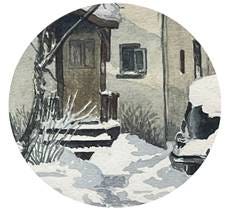
I kept seeing this image in those little, fleeting light spots that we have in our mind’s eye in the dark. The front door of the house where I was born, the steps, the stucco and a part of the car.
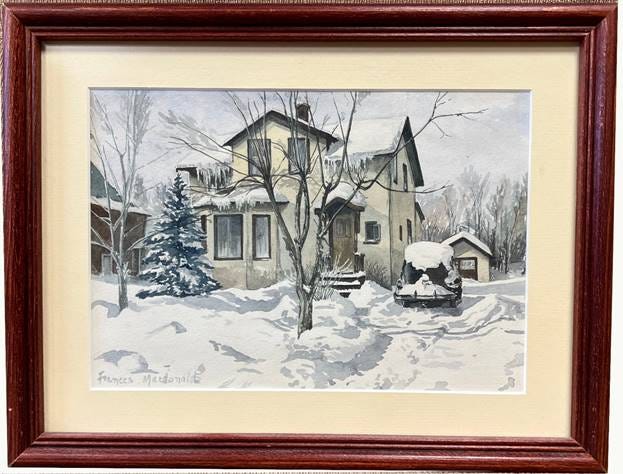
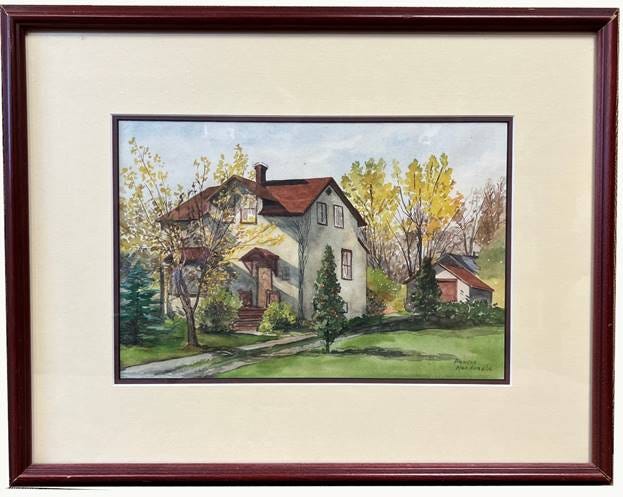
It is a small part of a winter scene she did of our home on Sunnyside in Pointe Claire; I imagine how cold her fingers must have become because I am sure she set her easel up on the driveway. It must have been warm enough, though, for the water colours. The images persisted even after I returned from France. They lasted, in fact, until one day I found the painting in my brother’s home, unframed but hanging on a wall. I asked for it. After that, the fleeting image in the dark was gone. We all worked together to frame those of her paintings in our possession and share quality reproductions. There were just a few. The first two are her painting of the house where I was born, probably painted in the late 1940s.
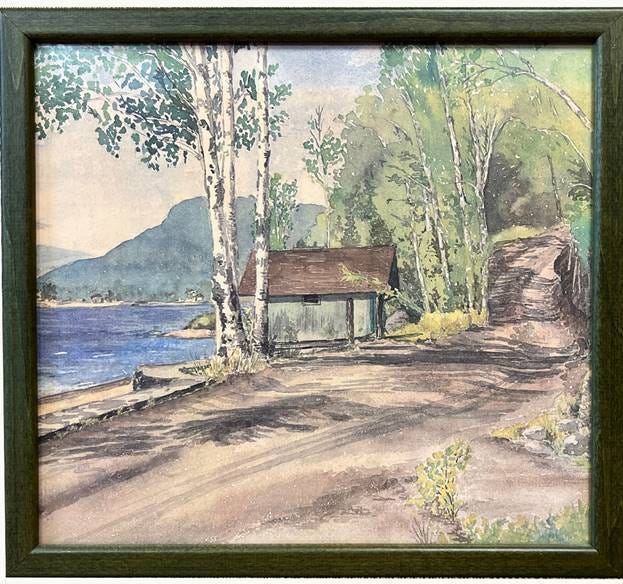
The only other two we have are summer scenes in Val Morin, in the country. Our cottage was on posts, and we could come only for the summer holidays. The cottage was ancient with a lot of its old wood interior, including the tongue and groove cedar partitions darkened with age. There was a rarely used stone fireplace, and a much-used wood stove in the kitchen. I can still see the chipmunks stuffing their cheeks on the roof of a shed just outside the kitchen window. Cedar dominated the cozy smells, and Tante Frances seemed like a permanent fixture, walking and cycling her rosary just the way she did in the city. We don’t have many photos of the house or of Tante Frances, but her few paintings carry the memories for me. The one below shows the narrow country road where it passed beside the beach and climbed beyond the Cockfield’s boathouse to my aunt and uncle Raymonde and Richard Paré’s place.
Walking up the hill on a sunny summer’s day, I was bound to find his mother-in-law, Tiva, in her flowers. As a boy, seeing her was a special event. She looked ancient but she was of the flowers and her smile radiated like their blossoms, her character-lined face expressing joy that seemed just for me. Learning later about her cultured family history explains those moments, carries them, but usually I had to continue on to our house beyond.
The other is of the changing house on The Rock, its own destination laden with memories of the generations. We played endlessly in the changing house, respecting our promise to not venture further on The Rock without a grownup.
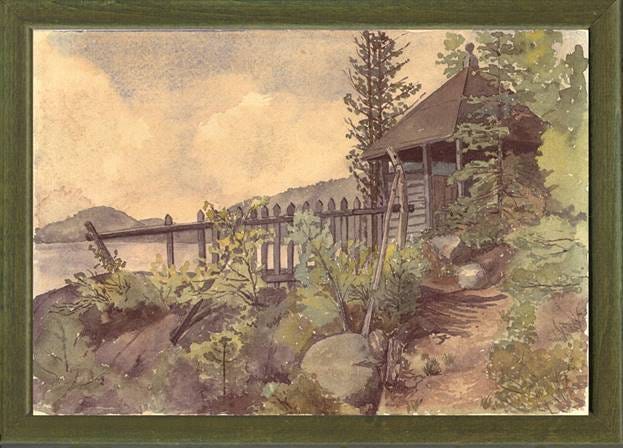
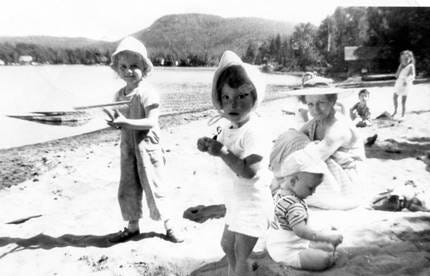
All these years later, I wonder if Tante Frances had been present while we played, would we have counted her as the requisite grownup and ventured further. I don’t remember it ever happening and believe she fit in a different category – perhaps being beyond grownup. She could certainly not have appealed to “Joseph, my friend…” at The Rock in an emergency, but the only photo I found of her was on the beach down the road, surrounded by children, including a very little “Joseph, my friend…”
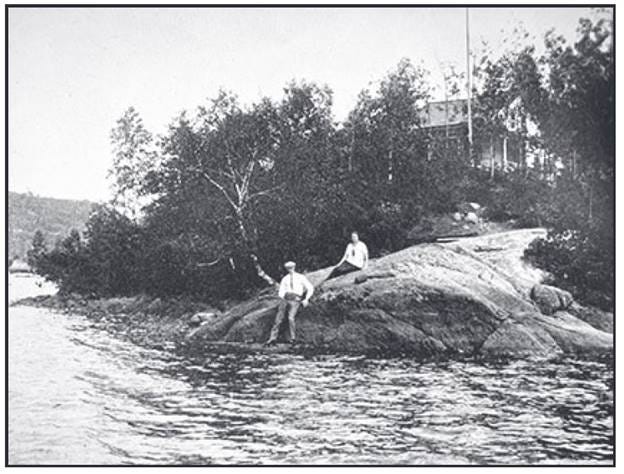
The Rock was a place of great importance. The photo below was taken in 1922, the same house Tante Frances knew sitting up above, but the changing house had not yet been built. People would come to The Rock occasionally to admire it. There was a depression it its centre where fires had burned over the millennia, all at a safe distance from the brush. I remember a geologist who happened by in his canoe with a companion. He came up on the rock and gave me a short history, even showing me a fossil that was a small protrusion that I had seen, but had never before considered its organic shape.
Mercifully for me, I do not remember Tante Frances ever addressing me as “Joseph, my friend…” when I had friends around. Sometimes her daughter, and granddaughter Louise Ethier, would come to visit. Louise was my age but a lot more sophisticated than me. She could hold adult-sounding conversations with the grown-ups even late into the evening when I was struggling just to keep my eyes open. I am sure I would have been deeply embarrassed if her grandmother had ever addressed me as “Joseph, my friend…” in her presence.
Thankyou for this truth… this image in those little, fleeting light spots that we have in our mind’s eye in the dark. 🙏🏼
Thank you for sharing these wonderful memories and paintings, Joseph my friend and brother x