

La Mère Ménard
Founding mother of what became Ste. Agathe and Val David

Flavie Ménard would have told you that no one messed with her mother, Marie-Charlotte Josephte (Chartrand) Ménard. Even Flavie saw her, not simply as her own mother, but also as La Mère Ménard. A giant of a woman, six feet tall and as powerful as an ox, she was for a long time the oldest person in the pioneer settlement in Beresford and Morin Townships, grandmother to many, midwife and elder. According to her descendants, she was from a French-Iroquoian family and that could explain her knowledge well suited to the pioneer farming community, the go-to person long before there were any kind of social services.
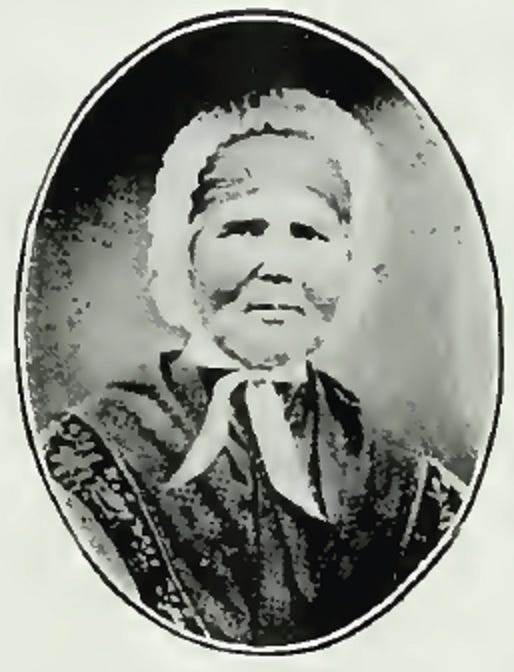
La Mère Ménard came north with her two sons and her daughter Flavie Dufrense, the very first colonists in the area. The men and women, along with the head of their family, La Mère Ménard, carried their worldly goods and walked the fifty-odd kilometres from St. Benoit to their new homestead north of everyone they knew. There were no real roads above Shawbridge, and a canoe and some portaging up the North River would have been a better way to get as far as Ste. Adèle but above that the ground rose too fast to use the river. There was a trail, however, cared for by the large Anishinaabe Commandant family identified with Mont Sauvage.
Ste. Adèle was 600 feet above sea level, but the elevation of the valleys between the hills where they were going was twice as high.
That was in 1850. The men had gone up the summer before to build some log cabins to receive them. They were homesteaders, families that could earn title to farms on condition they developed the fields, owned animals and built a home. Over the years, other colonists, young families, joined them and many had lots of reason to call the old lady ‘mother.’ She delivered a lot of their children. Her own children, of course, were grown up and so she had more time for the sick and for the poor. She was really the matriarch of the rough-hewn town that grew around her and she commanded the respect of a chief.
Doctors arrived eventually. The first was Dr. Luc-Eusèble Larocque, the oldest practicing doctor in St. Jerome. He had spent some crucial years in California, right in the middle of the gold rush. Doctors were needed there, too, and he came home with a tidy sum, determined to live a genteel life. He came up to Ste. Agathe in 1853 and bought half the land around Trout Lake. He wasn’t a homesteader. He prepared the farms and rented them out to people, hoping to live off the rent. The weakness in his plan was his big heart. He came out each year to collect from his tenants but spent the whole summer ministering to the sick instead. He collected so little rent that his many children inherited nothing but the beautiful poems he sent back to his wife to convince her to join him. She never did, though. Instead, she painted sweeping landscapes inspired by his poetry, which she showed him upon his return. Early records assure us that the poetry and art are preserved, but no one seems to know where they are today.
The Ménards, Dufresnes and other farmers worked hard cutting down the trees, hoping to work the soil beneath. The trees themselves, tall pines and maples, could have fetched a fair price but there was no way of getting them to a sawmill in the early days. The North River was too shallow and rough to float them. Instead, they burned them and sieved and washed the ashes to get potash or lye, depending on the tree and the process. Carried on their backs to St. Jerome, it fetched pennies per sack. Ashes were their only currency-producing crop and paid for the tools needed for the farm. As children, they would have grown up on the seigneuries in the rich, fertile St. Lawrence Valley where the farmers were tenants who paid their way in the world with wheat. It was Quebec’s major export until the mid 1830s when the crops were devastated by disease. Wheat never recovered as a significant crop, but the seigneuries had produced a prodigious number of farmers who could not imagine any other life.
When the fields were cleared, there were no more ashes to sell. Farmers hired out as lumberjacks, sometimes going as far as Illinois for the winter, just to make enough money to keep on farming. They also discovered that four to five days of hot summer sun could dry out the thin layer of soil on their hilly fields and bring on drought conditions. Watering before powered pumps meant all people could do was hope for rain. Curé Labelle, the promoter of colonization, arrived on the scene about this time. He began his mission in 1868. He told their children to travel north where they could homestead, cut down the trees and set up farms. It sounded pointless to the farming lumberjacks, just an invitation to repeat their own mistakes, but the curé was right. Further north, along the Rouge River, the soil was deep and the elevation was as low as Ste. Adèle. It was ideal farmland. Many went.
La Mère Ménard wasn’t affected by any of this. She had graduated to the title of La Vieille Ménard and lived in a small house on a lake south-east of Trout Lake that you can still find on some maps. It was called Lac de la Vielle Ménard (Old Lady Ménard’s Lake). She was kind, but it was best to do what she said. She kept a garden and she also kept some holes open through the ice on her lake where, during the long, hard winters she could catch trout when she needed to. As Flavie warned, though, no one messed with her, at least not after the story of one unfortunate fellow she spotted early one morning pulling trout out of her lake. She quickly left her house in little more than her nightie and grabbed the man. Folding him easily over her knee she gave him a good sound spanking.


Thank you Joe. What a challenging time these pioneers lived.
What happened to her husband?