

Lemuel Cushing, Beyond Chatham
Conclusion

The family of Lemuel Cushing is an English Laurentian success story. From Lemuel’s arrival as an unemployed teenager, finding work in lumbering and seeing business opportunities, he went on to marry Catherine Hutchins of Lachute in the mid 1830s. They raised thirteen children, most of whom left the village of Cushing, working in professional careers in Montreal.
The 1840s was a period of growth for the region, and Lemuel, young, dynamic and cautious, was well positioned to appreciate it and take full advantage of the opportunities. He was a councillor, mayor of the township and county warden as well as a very successful merchant and businessman. He was probably among the first to recognise the potential and importance of tourism, and acquired Caledonia Springs, a natural salt-water source in Prescott County, across the Ottawa River west of Hawkesbury. He built a hotel there, which he subsequently sold to William Parker. The original hotel was destroyed by fire soon after, and Parker built a larger one with the same name. Some years later, the property was acquired by the Caledonia Springs Hotel Company, of which Cushing was the most important shareholder. Caledonia Springs was a destination of choice during this period, and the developer counted among his clients Peter McGill and John Sandfield MacDonald, the lawyer who would become premier of the province of Ontario, as well as members of the Legislative Assemblies of both Lower and Upper Canada.
Lemuel Cushing bought and sold goods, maintaining a dock on the Ottawa River, probably at Carillon, and a home on Metcalfe Street in Montreal, in order to give himself the best access to the markets. Goods and products coming in and going out of the Chatham area were transported by water when the river was not frozen. That meant it was hard to get goods, not just to and from Chatham, but also to and from Montreal. Rail was the future. Cushing and his investments had already grown beyond Chatham, and he watched rail development closely, not just for Chatham, but for new opportunities.
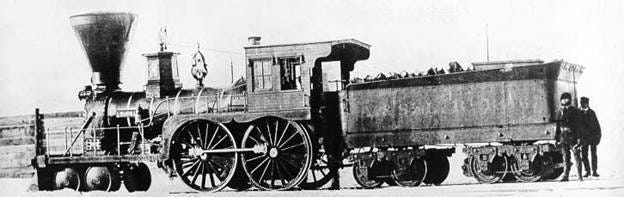
Like Chatham’s, Montreal’s shipping stopped when the St. Lawrence froze over. Montreal had grown to become an extremely important city, the largest British port in North America after the United States seceded. The Montreal Board of Trade in the 1840s entertained proposals from a number of coastal cities hoping to find a partner that could become Montreal’s winter port. Among the contenders was a group that proposed a rail line from Quebec City to Halifax and two American groups, one from Portland, Maine and the other from Boston, Massachusetts. The eastern colonies offered free land and petitioned the British Government to build their rail link entirely in the British territories, but the British could not see the importance, so the real rivalry rapidly fell to Boston and Portland. In fact, Boston was on the verge of signing an understanding when an enterprising lawyer named John Poor, who was promoting the Portland route, heard that the decision would be taken at the Board of Trade meeting in Montreal on Monday, February 10, 1845. He was in Portland in the middle of a blizzard on Tuesday evening the 4th, and he knew that his venture and the economy of Portland depended upon his presenting his option to the Board. In ideal conditions, he could have hired a sleigh and, with changes of horses, made it to Montreal in 30 hours, but under the circumstances, he had difficulty even finding a driver. He ventured out on his own to evaluate the possibility of making the trip and discovered fierce winds, hail and huge drifts of snow interspaced with glare ice. Undaunted, before sunrise he had found a driver, and they ventured north. The story of his trip is one of the great snow stories of the time. He lost his way 5 times in the storm-ravaged countryside, changed horses, drivers and sleighs, climbed 45-degree snowbanks with the assistance of local young men and teams of horses in towns that he passed through, and successfully covered the distance in 5 days, or 123 hours, instead of the usual day-and-a-half. Arriving in Montreal at 5:30 a.m. Monday the 10th, he slept for 3 hours before meeting with the Board of Trade and convincing them to postpone their decision to sign with his rivals.
An agreement was forged whereby a steamer would drop mail at Portland and Boston, for transfer overland to Montreal. Teams were set up along the route to assist both couriers, but the mail arrived from Portland in 12 hours less time than the mail from Boston. The distance from Portland was 246 miles, and from Boston, 351. Mr. Poor’s proposal carried the day, and the Atlantic and St. Lawrence Railway was established, leasing its services to the Grand Trunk in 1853.
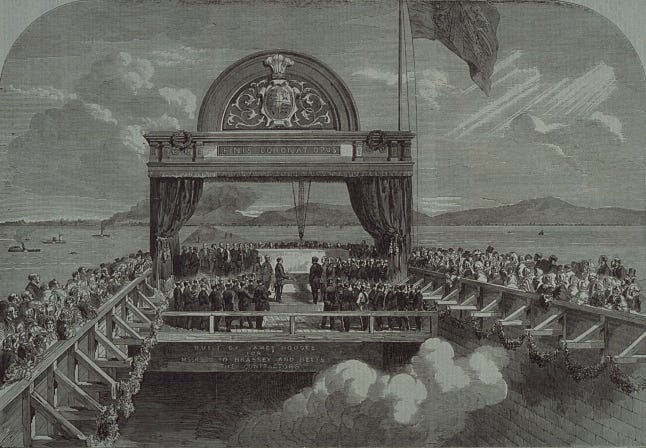
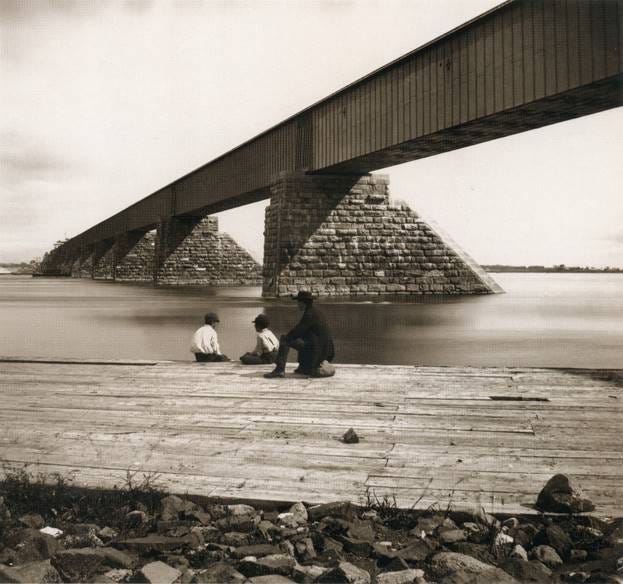
One of the biggest challenges in the building of this link to a winter port was the need to cross the St. Lawrence River. The Victoria Bridge, a tubular structure, was completed in 1859 and the last stone was ceremonially placed by the Prince of Wales in 1860. The first trains had already travelled across the bridge from December 1859.
The Grand Trunk was incorporated in 1852. Lemuel Cushing was deeply involved in Portland, and by 1859 he had acquired a large island in Casco Bay, Portland, called Bangs Island. It had once belonged to Ezekiel Cushing, a distant ancestor, who sold the island to Joshua Bangs in 1760. Cushing changed its name, and today it is called Cushing Island. Following through with his interest in tourism, he built the Ottawa House Hostel on the island. His son, Francis Cushing, converted the island to a vacation colony, hiring Frederick Law Olmstead, the same man who designed Mount Royal Park in Montreal and Central Park in New York, to landscape it. He also rebuilt the Ottawa House in 1888.
Each of the Cushings’ sons had notable careers, mostly in Montreal, and his daughters married into the same economic milieu as their brothers. Three of the siblings moved beyond our borders and two settled elsewhere in Canada. Only seven of their children survived their father.
On May 18, 1875, just a few weeks after his sixty-ninth birthday Lemuel Cushing took a nap at the end of the day and never woke up. He and Catherine were living in the home on Metcalfe but following instructions, he was buried in Chatham. His obituary in the Montreal Herald covered his life accurately and praised him as being respected and esteemed by all.
As was customary, Catherine was praised as his lifelong companion but no further information in the records describes her own departure.
If I’m not mistaken…wasn’t there a Cushing family living on Greenshields Point, in the 50’s/60’s….? Thanks Joe. B