

Memory of Salmon
We need our stories to rebuild the world

Heritage illustrates history. Heritage usually refers to a thing, what you or your community inherit – a rambling old house, a garden fence, a church, a memento. History describes the why, what it was, what it did. When the artifacts are gone, the stories can survive. They evoke the thing that fell apart, and they carry the meaning. One story that evoked such an image for me – that still exists in my mind so strongly that I can smell the grain being milled, hear the water flowing, see the flat, heavy boards of the mill – is the drowning of Mr. Clark in about 1810. The water wheel is turning and Mr. Clark, who left his grain for milling, is fishing for salmon below the dam. Like everyone else there, I lost track of him for that critical moment, but then I was not really there. It was a story I read. Mr. Clark was fishing for salmon – in Lachute!
The mill was on the North River, and I can hear the commotion when the other people at the mill discover Mr. Clark has fallen into the river. I learned about it 180 years later, but it still lives in my mind. Mr. Clark lost his life and his first name – no-one knows it today. Maybe we could search records and find it, find his whole life. Maybe we could even find the salmon.
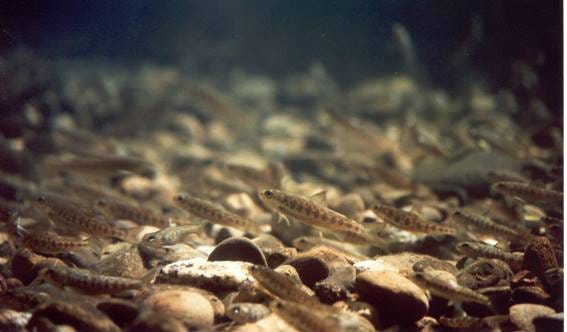
Are salmon a part of our heritage, our history? Was there once a salmon run up the North River? If the North, then they would have also run up the Rouge, the Lièvre, Petite Nation, as well as those many rivers that empty into the St. Lawrence. The salmon are what Mr. Clark’s drowning had illustrated in my mind. His story survived the mill itself, because of the salmon.
Those to whom we owe the forests, the rich soil found beneath it and the river carrying salmon are the people who lived in their huge pine and maple forests. Their very existence is and was the human manifestation of their ancient stewarding culture that comprised all life, including the rivers, the wind and the spirits. Their forests boasted white pine trees over a dozen stories high, reminiscent of British Columbia’s rain forests. The first white settlers did not see this as a heritage, but as something that could be turned into money to pay their livelihood. Before those settlers, there were traders who came to exchange for furs with the people here. The Maison Rouge, located west of St. Andrew’s, was a part of the Hudson’s Bay company. Its location could still be identified in the 1930s. Earlier still, before the Dutch and English gave the Mohawk guns in trade, the Algonquian and Iroquoian people co-existed along these forest paths and shorelines. This broad Indigenous neighbourhood was also where Radisson and des Groseilliers discovered the remnants of the battle made famous in the story of Dollard des Ormeaux in 1650. It was also along the Ottawa where Champlain travelled to meet Tessouat at Isle aux Allumettes, and where he said he released the young Vignau to his unknown fate in 1613.
The seigneurie of Argenteuil was first granted to Charles Joseph d’Ailleboust on June 15, 1682, long before it could realistically be considered as a part of New France. That did not stop Count Frontenac, the governor, from making the grant. The region was then solidly in the hands of the Mohawk and Oneida, who also controlled the waterways. They were at war with New France. The Haudenosaunee, of whom the Mohawk and Oneida were members, had organised the Covenant Chain to protect Indigenous Nations through trade. The French opposed it. The Covenant Chain grew out of a treaty made with the Dutch over 400 years ago. Originally it was called Kaswentha by the Mohawk and the Two Row Wampum by the Europeans. It still exists and is protected by our laws, although lawyers and governments often must be reminded.
Once Louis-Hector de Callières became the governor of New France, things began to change. Everyone could see that. Algonquian allies of the Wendat got together with the Haudenosaunee because they could see a chance to reach an understanding that would include de Callières. They succeeded with the Great Peace of 1701 in Montreal. The English, who were already partners in the Covenant Chain, had opposed the meeting and refused to come. Their enmity of the French was too strong.
It was that treaty that would enable the French expansion into Deux Montagnes and, eventually, Argenteuil. The seigneury began active development under a new seigneur, the young Pierre Louis Panet, in 1781, eighteen years after the end of the Seven Years’ War, and a century after the original grant had been made. Like the Catholic Church before him, he swore allegiance to the long-serving King George III of Great Britain.
By 1785, English-speaking colonists began to arrive, departing from the newly independent country to the south. The first to arrive were Loyalists, people who could not abide the idea of abandoning Britain, and they acquired some of the excellent farmland in the seigneurie, but the larger group were people who sought stability and opportunity that was not available in the young country they had left.
Jedediah Lane saw the potential. He had the money so he acquired a parcel of land on both sides of the North River surrounding the falls, or La Chute. He was a developer. He sold to rugged mountain people from Jericho, Vermont, who came for the trees, for potash and quick money. They cut and burned the forest for a dozen years. The Indigenous people must have been crushed by the devastation. It was their ancient heritage, being turned into money.
Mr. Clark fished for salmon, like many others probably did. The mill is long gone, as is Mr. Clark’s first name and the salmon. The memories are ours, though, to share, and to remind us that our rivers could again carry salmon and our forests could grow back. Without awareness of those memories, without knowledge of our history, we lose it all.
I love to follow your stories
Thank you for keeping the stories alive, Joe.
In the garden of my former home in Mont Tremblant, the largest White Pine in the area still exists.