


Over the millennia, Algonquin and Innu parties picked their way down the rapids of the North River below Lac Raymond near present-day Ste. Margeurite Station. They saw a strange, bare mountain, a rocky hump, a landmark, telling them how far they were from their destinations. They surely named it, but their name has not come down to us. Much later, in the 1840s, and ’50s, the first settlers moving beyond A.N. Morin’s experimental farm in Ste. Adele may also have named it, but if they did, their name is also forgotten.
Still later, the surveyors who located the railroad along the bottom of the river’s valley would certainly have seen it, and perhaps they even indicated it on their first plans. If they called it anything at all, that name is lost to us too. Even the many passengers who came up the line after 1891 seem at best to have observed it passively. It remained unnamed until the first skiers found a purpose for it.
Aleksander Olsen, a Norwegian engineer who moved to Montreal to design grain elevators, won five combined ski jumping and cross-country competitions at the Cote des Neiges jump between 1911and 1916. The jump was on Cote des Neiges across from Decelles. Like many other Norwegians, he took full advantage of our winters, skiing wherever and whenever he could. Cote des Neiges and the park boasted trails lacing all over the mountain, but Olsen and his friend Sverre Øsbye did not limit themselves to Mount Royal Park. They used the train to go up to the Laurentians where the snow was deep and conditions always reliable.
The steam engine could not pull the whole train past Ste. Margeurite Station, so it had to stop there and pull the train up to Ste. Agathe and Square Lake one half at a time. Olsen and Øsbye were not likely to have had the patience to wait for that kind of manoeuvring. Outside the window, the snow looked too tempting. Abandoning the train, they took off through the woods along the North River.
Some of the early hills they identified served only as landmarks, means of finding their way back to the railroad station at the end of the day. One of these markers was that same rocky outcropping whose name had still not been established. Olsen and Øsbye used it to orient themselves from their first winter visit in1911. They could see it from anywhere in that part of the North River Valley, and, with Olsen’s engineering training, it was easy to judge the angles of view and find their way back to the station to catch the home-bound train.
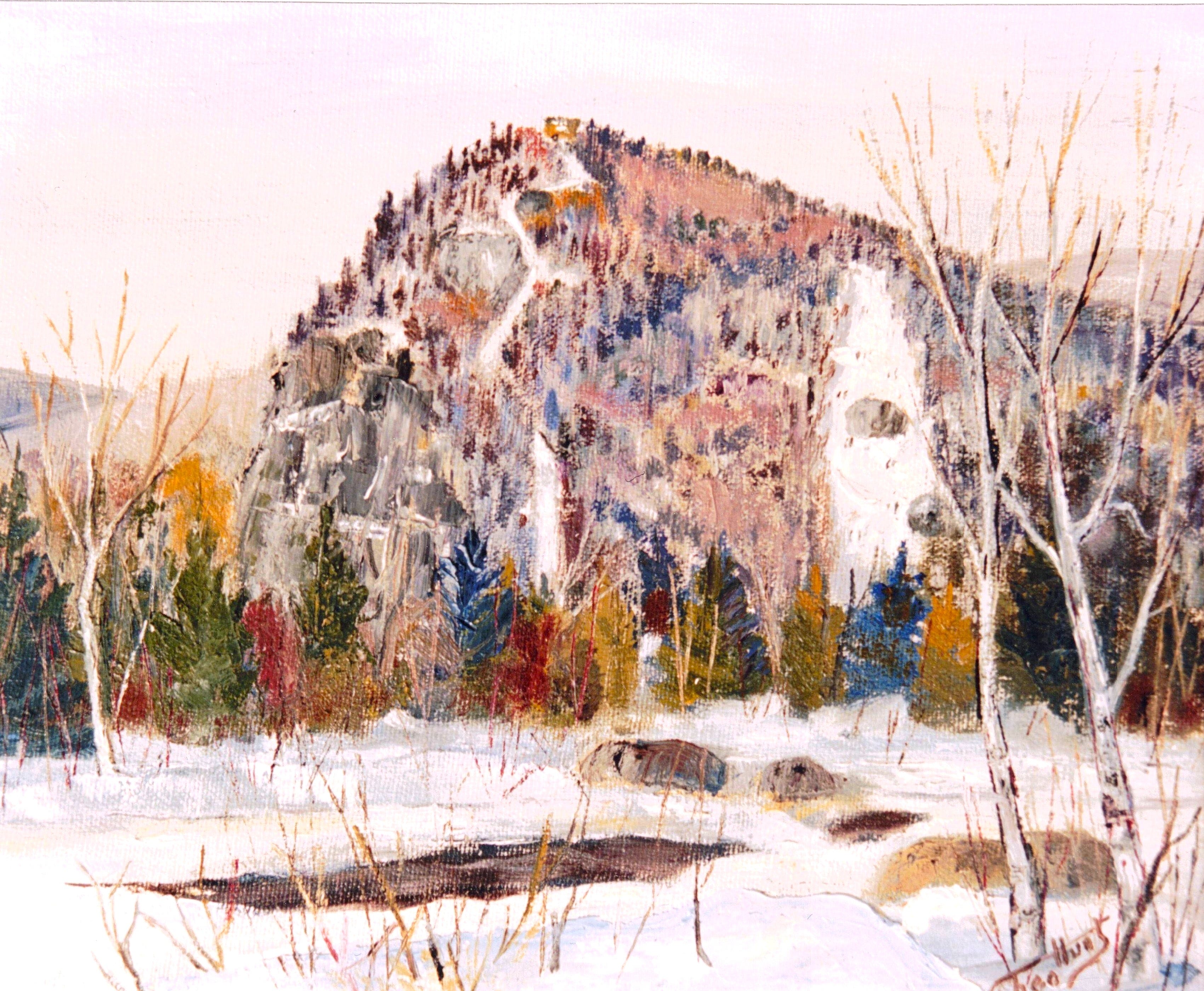
Mont Baldy: Painting by Théodule Huot, Ste. Adele, courtesy Normand Huot
In my childhood on Lac Raymond, we went for outings down the falls below the lake, and we learned about the mountain. In fact, it developed significant religious value to me because my mother invoked it when she shared her oft-repeated lesson of how faith could move a mountain. I would look at it and imagine it being moved. If those early skiers had known that they may have had less faith in it as a landmark, but it would not have stopped them from trying to conquer it. Olsen and Øsbye did. With other courageous—or crazy—young men, they climbed it and found their way back down, a good day’s exercise.
After Olsen and Øsbye returned to Norway in 1916, skiing continued to gain popularity in the Laurentians. In 1917, Émile Cochand opened the first dedicated Laurentian ski resort not far from the bald mountain, and soon trails were being marked through the woods and skiers glided from hotel to hotel. Øsbye stayed in Norway, creating the first commercial ski wax, but Olsen returned to Montreal with his new wife and son, Kaare. He continued to work in construction, and in the 1930s he used his professional skills to design and rebuild the ski jump on Cote des Neiges, the site of his earlier championships. His construction was a turret-style ski jump, known for its size. Jumping had become so popular that 3000 to 4000 spectators would come out to watch the competitions, which could include 150 or more contestants. Coming from Three Rivers, New England and Ottawa, they were often accompanied by military bands playing ‘oom-pah-pah’ and spectators milling around. The cross-country aspect of the combined races took the contestants from the turret ski jump up Westmount mountain, down across Cote des Neiges Road, up Mount Royal, around the Cross, through Outremont, back down to Decelles and across Cote des Neiges, where organizers would shovel snow on the road and the tram lines to allow them to get back to the starting point.
Skiing became so popular that people, following the pioneers to the Laurentians, even began to regularly climb the bald mountain and race down as best they could, like Olsen and Øsbye had done. Contestants and participants in these races included people like Pierre Cochand, Viateur and Emile Cousineau – and my mother, Pat Paré. She shared the story of Heinz von Allmen, who at one time ran the ski school at the Alpine Inn. He made it down Mount Baldy in 57 seconds, the second fastest time recorded, and thereby earned the nickname Heinz 57, the well-known steak sauce. Emile Cousineau held the record for the fastest time, at 56 seconds.
Kaare Olsen remembers his father telling him that he and his friend Sverre Øsbye called the rocky outcropping Mount Baldy, and the name stuck. Today, many people know the mountain that way, and the road running along the North River near Ste. Marguerite Station is called Rue du Mont Baldy, but if you want to get a really good look at it, you might want to put on a pair of skis and ski along the linear park over the old railroad line along the river. You might even have to get off the line and ski into the woods, but you won’t get lost if you see it. You can always use it to find your way home.
Thanks to Kaare Olsen of Hudson, Normand Huot, and the late René Bauset
Great piece, Joe. It does what the mountain itself does, strips away the present tense and lets the past come rushing in. Thx.
Seasons Greetings Joe. Man this story stirs up many memories…exploring around Lac Raymond with you….your lovely Mom….hiking up and skiing down Baumgartten (sp) under the stars….the wild Cochand Clan. Thanks for this. ❤️B