

‘Nature,’ a Human Artifact?
Nowhere to run…

In his book Songlines, Bruce Chatwin describes the difficulty that the Indigenous peoples of Australia had with airplanes. In their creation mythology, songs came first. The world was sung into existence, and their cultures were remembered in songs that were passed down through the generations. All things were explained through song, and families were identified through their songlines. If it was not in the songs, it didn’t exist.
That was where the airplanes caused a problem. They were definitely flying overhead, making noise and acting like they really existed, but they weren’t in the songs. Thankfully for aviation, this 40,000-year-old culture solved the problem by singing the airplanes into existence.
Contemporary society, looking out through the airplane window, swings from the end of a long organic thread woven through influences and conventions that have allowed us to coexist in a certain ruthless harmony. The long tendril of our past weaves through time and curves back upon itself, deceiving us into seeing our beginning as something other, something outside of our experience. What we see often leaves us feeling alienated and resentful, wanting to jump free from our human constructs to find our true selves in nature. We have lost our ability to see ourselves, our edifices, our man-made environments, as natural.
Living in the Laurentians, I am perceived to be “living outside” of the city, in an unsullied woodland where everything began. City people come here to be free from human constructs, to be away from the steel and concrete of the city, to experience the outdoors, where trees grow in the sunshine and animals and insects live among them in a harmonious environment that has existed from time immemorial. They want to get back in touch with something that they feel they have somehow had to forego. These city dwellers appear to be serving at the front of a war that we are slowly losing. They come to the country to breathe real air and to regain their courage to return to the frontlines. Their country retreats must be environments finished in wood and stone with a discreet access to the necessary road systems and a view of untouched, untrammelled nature in the back and side yards. A living room window that looks out over a road at the vista of rolling hills, mountains and perhaps a lake is destroyed if the road can be seen. One lovely property was devalued because, although the road was invisible, the view of a lake was seen through the horizontal lines of the electrical power system – our power – our capacity to live in our society. Perhaps, I wondered, if these parallel horizontal lines could be seen as a stave ready to receive the notes of a musical score, perhaps if a series of birds sat on them in just the right places, big, round black birds with long tails that sang – then maybe these wires would have a welcome place in the view.
Sometime after Covid, I met a doctor who told me he was looking for a really isolated place to live where he and his family could be removed from the risks of disease. I asked him if he was planning to give up practicing medicine. “No”, he told me, he needed to work to be able to afford to buy the refuge he envisaged. But, I thought, wouldn’t the doctor himself, working in a hospital, be the carrier of the risk he wished to escape? The city people come to the country, but necessarily bring the city with them.
It is us.
We are all carriers. “Country” people are just the ones who live on the periphery of the urban world. Farmland subsists on the spaces between, and for the benefit of, the cities. We in the countryside have a perspective from the outside looking in, a slightly objective view of city life. From here, the city is very much alive. It appears as a gigantic organism that has digested rock and steel in its growth and sends its tentacles, highways, power lines, out into the countryside. Rather than living outside, we in the country live on one of those tentacles, a part of the monster. The city impinges upon the country, threatening to remake this “natural” environment in its own image, but is it consuming a pristine, natural environment free from human intervention? What is this nature that is being consumed?
In his book 1491, New Revelations of the Americas before Columbus, Charles C. Mann summarised our changing view of the American continent before the arrival of Europeans and, in a nutshell, described how we are learning that the whole “natural” environment was so influenced by human presence before Europeans arrived that it must be seen as a human artefact. This is believable when one thinks about European landscapes, but the Americas were supposed to have been pristine untrammelled nature. Not so, Mann suggests. Even the Amazon rain forests are arguably built environments, as are the Algonquin forests. The wild country that Europeans “discovered” was in fact the residue of a great civilization that had been sent reeling by the clash of contact. Mann describes the explorations of Hernando De Soto in the early 1540s and what he saw. De Soto arrived in Florida with 200 horses, 600 soldiers and 300 pigs. He wandered through what is now nine states, from Florida to Texas, contaminating everything in his path, but the descriptions of what his men saw run contrary to our images of the American South before the arrival of Europeans. One survivor of his party described the area that is now Eastern Arkansas as follows: “Very well peopled with large towns, two or three of which were to be seen from one town.” His men went on to describe a cluster of small cities, each protected by earthen walls and sizable moats. No European returned to that area again until LaSalle came through 140 years later. Where De Soto had seen about 50 “large towns,” LaSalle did not find a human settlement for 200 miles. Where De Soto found an established civilization, LaSalle and his successors found roaming buffalo and occasional nomadic villages. Similar reports of abandoned forests have come down to us regarding New England and we know that Jacques Cartier met Iroquoian Nations in the St. Lawrence Valley in the 1500s but 70 years later, Champlain found Algonquin, Montagnais and Huron Nations. The St. Lawrence Iroquois had vanished. In the south, nthropologists blame De Soto’s pigs, brought along as a convenient meat supply, for the devastation. Elsewhere it was simply contact, shock, our diseases. It happens almost every time cultures collide, but it does not mean that the arriving culture found a wild, natural environment. Everything they found was a human construct or the aftermath of one.
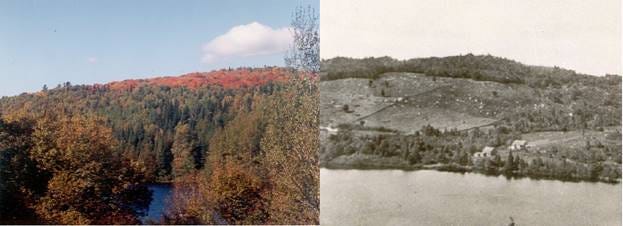
Contemplating this, it is easy to see that the Laurentians are covered in second-growth forests that grew wild on old farms, abandoned as a new technological culture spread into the area. The evidence is apparent from your car window in the autumn when the leaves change colours at different times in different abandoned fields, the colours following the old fence lines. These farms had in their turn displaced earlier human-influenced structures. Nature has been a human construct for thousands of years. There is no outside, no natural refuge.
It is all us.
I dozed off sitting in an easy chair in my living room the other afternoon. Soft music was playing on the stereo and the book on my lap was failing to hold my attention. My wife, sitting in an identical chair across the room, read quietly and, between us, large matching sofas stared emptily at each other across a cluttered coffee table. My slumber was profound and I sank into another world of unawareness. For a short while, I was not. Eventually, some part of me returned and my eyes opened and gazed, entranced, from a sleeping brain. I took in the sofas, the table, the clutter, my silent wife and I saw a room alive before me. The sofas were engaged in deep silence with each other as though the occasional human occupants were only one expression of their continuous exchange. The table fully participated and the other chair enjoyed my wife and the story that was currently animating her. The window behind one of the sofas formed no barrier with nature; it flowed equally in and out through the glass. Everything shared the soft music. Everything was animate. As we swing on the thread spun through our civilizing influences, alienated from the green world of our past, let us hope that we can learn from others and sing our own nature into existence.

An earlier version of this story appeared in Liberté magazine #266, Habiter hors de, guest edited by Louise Lachapelle