

Philomen Wright and Jedediah Lane in the Algonquin Forest
The tall forests that covered the land from the Atlantic Coast to the Great Lakes were not an accident.

Philemon Wright, the founder of the town that would become Hull (now Gatineau), came north for a business opportunity around the same time as Jedediah Lane acquired the land that would become Lachute from Patrick Murray, the seigneur of Argenteuil. Murray needed cash and he gave up his seigneurial rights on this parcel. Philomen Wright differed in some significant ways from Lane. Wright was a farmer from Woburn, Massachusetts, and believed in agriculture as the key to the success of any new settlement. Lane was a speculator looking to make money through a real estate scheme. Wright tried to find settlers from the newly minted province of Lower Canada, but when they did not respond he sought people from back home, looking for farming experience. Lane was promoting his settlement back in Jericho, Vermont, a rugged mountain area with limited agricultural knowledge. His people came for the trees.
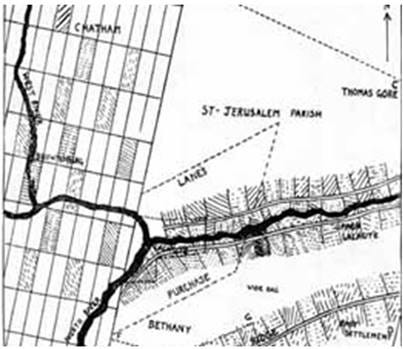
Another difference between the two men was that, while they both arrived in the 1790s, Lane acquired a parcel of land in a seigneury and Wright thought he was buying four townships, Harrington, Namur, Grandisson and half of Hull. In Lane’s case the title was clear, even though he did not seem to understand the seigneurial system. Wright’s case was completely different. Having contracted to pay Jonathan Fassett of Bennington, Vermont, six hundred pounds sterling for his land grant, Wright experienced his first setback. Fassett’s grant had been revoked.
Another man may have gone after the seller and spent angry years recriminating, but not Wright. He had become hooked on the Algonquin forests and rivers. He saw good agricultural prospects. Wright had to demonstrate to the government of Lower Canada that he was part of a large group wishing to establish a community – a colony. Without abandoning his ambition to own a large parcel of land, he focussed on acquiring the half-lot of the projected township of Hull, a fraction of his original dream. His settlement would comprise 37 men, 5 women and 21 children, virtually all sponsored by him, who agreed to repay his sponsorship by returning to him the major portions of the land they were granted. In that way, of the 13,200 acres they acquired for their settlement, Wright recovered all but 1,000 acres. The whole process took ten years, from 1796 to 1806.
At the same time, he accepted to pay a lease to the Anishinaabe, in this case the descendants of the powerful Kichesipirini, and Weskarini and others who had been guaranteed the land in the Proclamation of 1763, not all that long before. These Indigenous Nations welcomed him. They visited one of his early worksites with gifts of maple syrup and sought an interpreter who could translate for them. Why, they wanted to know, was he cutting down the very trees that provided this wonderful gift of nature.
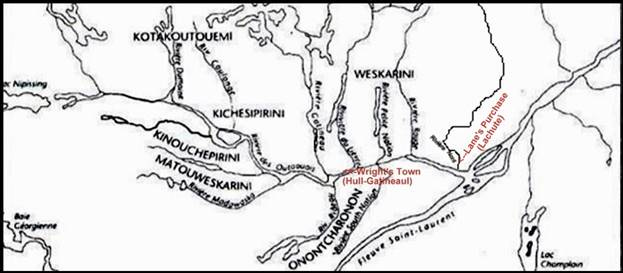
The Algonquin forest was a human artifact that had been nurtured by these same people for millennia. They had blocked Samuel de Champlain from travelling freely on the Ottawa River and had been the keystone species of these forests. Wright met only a small remnant of their once-great nations. Struggling to recover from the many new European diseases that had destroyed their communities and their culture, they had become like refugees in their own forests. They lacked both the numbers and the convictions of their ancestors. Disease had taken the elderly and the children. The elderly were the repository of their cultural knowledge. The people Wright met were the survivors. They could not resist the incursions of colonists because they lacked the numbers necessary. Wright, treating them as one would treat children, suggested that they should have more confidence in the wisdom of their wise father, the King. Eventually, even the charade of a lease was abandoned and these Nations moved further north to avoid starvation. They lost the great wealth their ancestors had stewarded since time immemorial, an injustice that has never been properly acknowledged. Even today, some of their descendants are treated as squatters on their traditional land, unrecognised by our provincial and federal governments.
Lane and his settlers, having had no delays like those Wright experienced, proceeded to exploit the new-found wealth in a difficult market period. He was exploiting the same Algonquin forests, but the reduced demand for logs and the costs of transporting them meant that it was more worthwhile to burn the trees and sell by-products such as potash and lye that they could make from the ashes. They saw the forests as a quickly harvestable cash crop, but because they lacked farming experience, they became dependent upon others for food. By 1810, those who had earned cash could leave with their profits, but the remaining community succumbed to famine and collapsed. It was Thomas Barron and a group of fellow Scots with a strong farming background who rescued the agricultural land and set Lachute on its path to prosperity. Meanwhile, Wright had thought himself a farmer from the outset.
Wright’s determination to farm meant that his small community, called Wright’s Town, gave priority to producing the food needed to sustain it, and this, coupled with his 10-year delay in starting, meant that the Algonquin forests in Hull Township were still standing when Napoleon effectively blocked British access to the Baltic Sea and its supply of pine.
The British Empire boasted the largest navy under sail in the history of the world. Aside from countless merchant ships, there were hundreds of battle ships patrolling the ports and seas, all in constant need of repair or replacement. A ship of the line could be 170 feet long, its hull and solid wood superstructure built to withstand the forces, not just of the sea, but also of the 74 cannons mounted on its two decks. The mainmast itself was made from a single timber 11 storeys high, with a base diameter of three feet and little tapering to the crown. One boat required over twenty masts and spars, each a unique timber, and the forests of the British Isles had long been exhausted.
As well as size, masts and spars had to be able to flex under sail. The desperate need for these forests had driven the British as far as Australia where they discovered Norfolk Island, just off the coast of Australia, covered in a forest of ideal-looking pines. These perfectly tapering trees, they learned, would “snap like a carrot” under load, according to Robert Hughes, author of The Fatal Shore, the story of the British colonization of Australia.
Philemon Wright had fought in the Battle of Bunker Hill during the American War of Independence, and in that war the British had lost access to the huge pine forests of New England. He would have known that an early flag of the newly independent America featured a white pine. He may have recognized the white pine along the shore when he first sailed up the Ottawa River to take possession of his new settlement. Still, he saw himself first and foremost as a farmer.
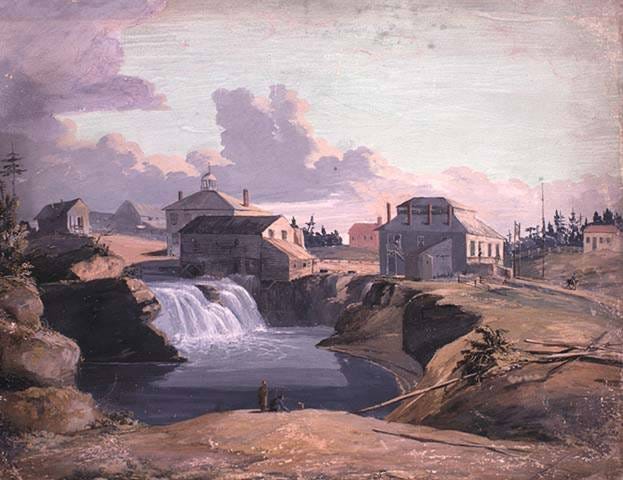
In the early decades of the 19th century, wheat was vying with furs as Lower Canada’s major trade product. The lumber market was growing and would surpass the other two, but Wright saw wheat as the backbone of the economy of his small settlement. By 1810, he had erected gristmills, and he was producing potatoes, oats, corn, hemp and wheat. His wheat crop alone rose from 3,000 bushels in 1813 to over 35,000 in 1820 and 76,000 three years later. He also maintained prize herds of cattle. By 1817, of the 135 labourers hired in the township, 120 worked directly for him, but he could not resist the British navy’s demand for wood. The profit from that kept him afloat, as will be described in Wright’s Rafts next week.
Wow…powerful image of the impact of the loss of the Algonquin forests on 1st Nations….