

Pine Tree Road, Echo Lake, Morin Heights

There was a ski jump on Cote des Neiges in Montreal that challenged the young George Binns. Even his recent marriage could not quieten his daredevil spirit, but the ski jump played its part one fateful day when a bad fall resulted in a broken back. After an operation, he was told that he should spend time at his family’s country house on an old farm that bordered Lake Echo in Morin Heights.
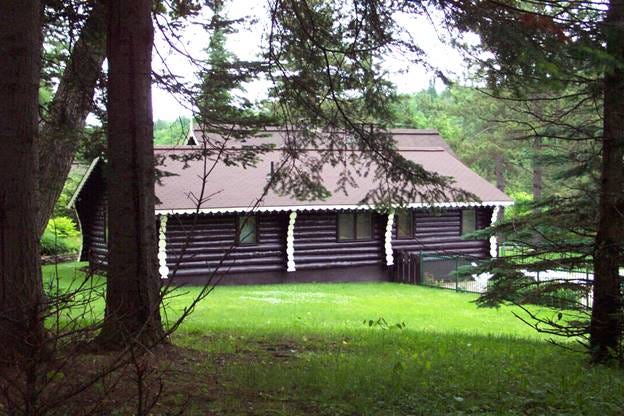
Binns, an engineer, used his convalescence to build a log home on a parcel of land he acquired from the Seale family. While he may not originally have intended his home to be a business project, in 1934, in the thick of the Depression he sold it, bought the adjacent parcel of land and built another one. That was how the Log Village of Lake Echo began. His round log homes nostalgically recall an earlier period when the forest was a driving force behind our economy. Their appeal was so great that even today they are cherished and prized.
When the first Europeans arrived, they were confronted with a woodland that stretched from the East Coast to the Great Lakes. The forest reached 90 to 150 feet high, with trees in some areas as high as 250 feet. To put it in perspective, it was a 9 to 15-storey high forest, and in some places as high as 25 storeys. By contrast, most of our local forests today are 4 to 6 storeys high. Our ancestors saw this magnificent forest as overgrown fields. Catharine Parr Traill, the author of The Backwoods of Canada, sailing up the St. Lawrence in 1832, is quoted as having seen only “…a great portion of forest which it will take years of labour to remove.” This attitude was the first reaction of the newcomers, right back to the 1500s.
We have never fully appreciated that the First Nations of the northeast were a woodland people. Their civilization lived in a huge pine forest, and they guided it in a way that was, and still is, unrecognizable to us. They burned carefully under the canopy, encouraging new growth to attract grazing animals, and controlled what would seem to us wild herds of deer, culling out the weak. They did not stand a chance against the Europeans because a basic understanding in their society was seeing themselves in a family of plants, animals and spirits and accepting their role as the youngest sibling. The concept of ownership ran contrary to this. As a result, they had not acquired a tolerance for the diseases, as had the Europeans through their proprietary relationships with their herds of sheep, goats, cattle and pigs. Whole communities succumbed to these diseases, leaving empty forests with the remnants of great nations looking on in awe and fear at the European invaders, human and animal.
Some, such as Captain George Weymouth of the British Royal Navy, saw the great potential of the wood for masts and spars. In 1605, he sent back samples and seeds to England where it was discovered to be superior to the Scotch pine being used at the time, but the American white pine refused to grow in Europe. The British had already exhausted the forests of England, Scotland and Wales and they were dependent on imports to support what would become the greatest navy under sail in all of history. Robert Hughes, in The Fatal Shore, the story of Australia’s founding, described one English ship, a man-o’-war: “The mainmast of a 74-gun first-rater was three feet thick at the base, and rose 108 feet from keelson to truck — a single tree, dead straight and flawlessly solid. Such a vessel needed some 22 masts and yards as well.”
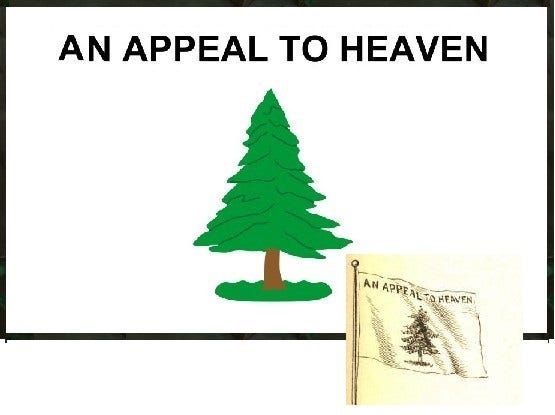
One of England’s rivals on the sea was Denmark, and it was strategically placed to keep the British out of the Baltic, the only remaining European source of pine trees. The English rapidly became dependant upon the trees they found in North America, and all white pines of a certain size were reserved for the navy. They would be identified with the mark of the broad arrow, pointing straight up along the trunk, and once marked it became a criminal offence to take those trees. Naturally the colonists resented this kind of expropriation, and it became as volatile an issue for the northern states as the Stamp Tax was. According to Sam Cox, author of The Story of White Pine, American Revolution, Lumberjacks, and Grizzly Bears, “The Massachusetts Minutemen who fired the first shots of the American Revolution at Lexington in April 1775, carried a flag of red with a green pine tree emblem on a field of white with them into battle at Bunker Hill in June 1775…” The Americans were supplying the French Navy with their masts throughout their war of independence. After the war, the New England supply was no longer at the disposal of the English navy, and the British looked far and wide to replace it. The early explorations of Australia were prompted in part by the discovery of Norfolk Island off the Australian east coast. The island was covered with tall, straight pines, but they were discovered to be worthless for masts and spars. Unlike the white pine, their resin dried brittle and inflexible. Under sail, the mast would snap like a stressed carrot.
The French also tried to keep the British out of the Baltic, but Napoleon was more successful than his predecessors. He made treaties with the small German states and together they blocked the access, putting increased pressure on the pine trees in the Canadas and in New Brunswick. There was less resentment in the Ottawa Valley to the mark of the broad arrow because the pine forest was the impetus for development, and while the need for masts and spars got things going, Napoleon was soon defeated and the British Royal Navy, secure in its control of the seas, became the guarantor for the export of squared logs. Soon huge rafts of timber were being floated down the Ottawa to Quebec via Rivière des Prairies and exported to England. These rafts were as large as fields, and they were sailed down with crews living onboard for months at a time. Each raft could be made out of twenty cribs attached together in such a way that they could be detached to race separately through river rapids and be re-attached below. In this way, lumber exports began to displace furs as the economic engine of the colonies. From 1802 to 1819 the export of timber soared from 21,700 tons to 340,500 tons. In the meantime, the American pine forests were falling to the lumberjacks’ axes, and regions that had once been magnificent woodlands were becoming farms and towns.
The growth of exports continued, but logging was a wasteful practice. Trees were felled and the trunks hauled away, leaving huge residues on the forest floor and exposing the land to erosion. Fires could rage out of control on the waste wood and on more than one occasion, lumbering towns were consumed. In the worst fire in the United States, 1200 people perished in the obliteration of the logging town of Peshtigo, Wisconsin.
By 1900, the pine was becoming rare. In a disastrous attempt to protect it, the American government encouraged the planting of seedlings. To keep pace with the demand, seeds were exported to Europe to be grown into seedlings and re-imported, unwittingly bringing back with them the devastating white pine blister rust. This fungus spread across the remaining white pine stands and dealt them a near-fatal blow: We had discovered why white pines do not grow in Europe.
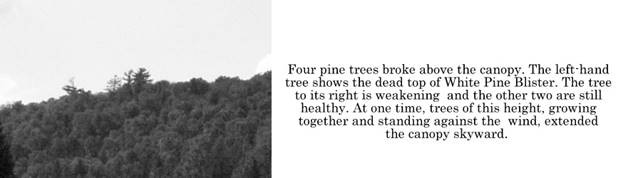
The pines are slowly recovering. They are more striking in our time for their dead, jagged tops. The virus causes the top of the tree to die as new branches slowly try to replace the crown, leaving large, wide trees sometimes without crowns and sometimes with more than one. If you are travelling towards St. Sauveur from the north along the Laurentian Autoroute, you can see one spectacular example of a crownless pine on the horizon in the distance. You will note that the breadth of the branches at the surviving top of the tree is as wide as some trees are high. Even so, it stands above the canopy. Sketch a mental triangle up to the departed crown and you will have an impression of the tree’s potential.
George Binns never had the opportunity to work with the huge original pines. I am sure he would be pleased to see how many tall pines and spruce tower over his little cottages at Lake Echo today. One summer around 1978, the residents named the streets in the little development where Binns had built his log homes, and one of them is Pine Tree Road.
Pine Tree Road is far from the only placename that commemorates this great Indigenous-guided forest that we have lost. Every Laurentian town and village has an Avenue des Pins or a Pine Road, but today the pine is a rare tree in the Laurentian forest. Sometime while you are driving you might spot one, a large, wide tree pushing above the canopy on the top of a mountain, a jagged, gnarled silhouette standing alone against the sky.
Merci Joe…yes the beautiful White Pine…I think some indigenous nations refer to it as ‘The Tree of Peace’… out east anyway. The Western White Pine was/is also hit by the pine blister fungus. The Ponderosa pine out here are more prevalent thru the grasslands and very impressive. Thanks again pal. Be well, B
Thank you Joseph. I learn so much each Saturday!