

Rawdon, Quebec
The story behind the name

Sir Francis Rawdon, a hero of the American War of Independence, was honoured in the creation of a Loyalist settlement east of St. Jerome, in Lanaudière. The township and municipality of Rawdon have a rich history thanks in part to the Volunteers of Ireland who served with him in the battles of Monmouth and Camden and the general’s own story grew and spread across the British Empire.
In 1771, the year Francis Rawdon enlisted as an ensign in the 15th Foot Regiment of the British Army, a famine devastated Bengal (present-day Bangladesh and West Bengal) killing one sixth of the population and seriously draining the British administration’s resources. As a corrective measure, the British government introduced the Tea Act, a tax that would effectively subsidise the East India Company. While it may have succeeded to some degree there, it also led to the Boston Tea Party, contributing to the colonists’ alienation and the American War of Independence.
Rawdon, a 17-year-old recruit, and his regiment were shipped out to fight in the American colonies. There, he distinguished himself in the Battle of Bunker Hill and fought in the Battle of Brooklyn and Whitehall. By 1778, at age 24, he had risen through the ranks to become a lieutenant colonel and was assigned the post of Adjutant-General to the British Forces in America. The role of adjutant-general could be described as the executive officer to the commander-in-chief. He raised a corps called the “Volunteers of Ireland” and his conduct in the battle of Monmouth earned him command of the left wing in the battle of Camden in 1780. He was the commander of the British garrison in the Battle of Hobkirk’s Hill in 1781 in which he defeated the superior forces of General Greene.
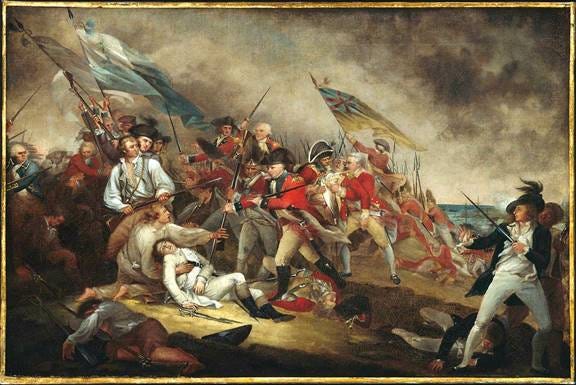
Whether it was because of poor judgement in his ordering the execution of the American colonel Isaac Hayne or because of failing health from exhaustion, he was called back to England. Before his departure, though, he helped establish many loyal British subjects, including perhaps many of his “Volunteers of Ireland,” in both Nova Scotia and Quebec.
Captured by the French on his return trip and subsequently released from detention in Brest, Rawdon arrived home to be honoured with a peerage in 1783. In 1789 his mother succeeded to the Barony of Hastings, and in 1793, upon the death of his father, he became the Earl of Moira, County Down, Northern Ireland.
In 1794, Rawdon was again in the service of the Crown, leading 7,000 troops in Flanders in the war against the French, serving with distinction under the Duke of York. As he proved in America, he was always concerned for his men, and despite his heavy responsibilities, he is on record as having objected to the eviction of Catholic tenants from one of the districts of Moira in 1796, and is credited as a champion of the Catholics in Northern Ireland for his efforts to publicize their plight. It is intriguing to imagine that some of the evicted Irish tenants of Moira may have made their way to Canada and been among some mysterious Irish immigrants who are reported to have illegally homesteaded in Rawdon, Quebec. There would be continuity in this, connecting the Irish estate of the Rawdon family with the Quebec township that bears his name. Perhaps some link exists, but the official lists have not been able to establish a connection and the mysterious Irish immigrants moved on, fading out of history in the face of land grants made to the Volunteers of Ireland.
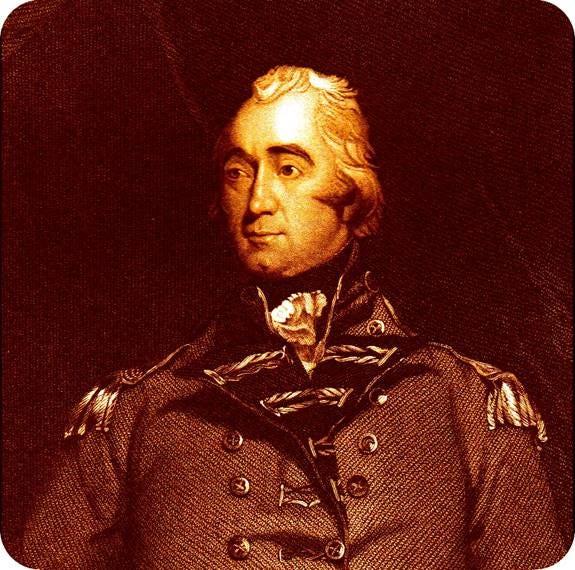
In the meantime, Rawdon was named Commander-in-Chief in Scotland in 1804, where he married Flora Mure Campbell, Countess of Loudoun, and the following year he was named Lord Lieutenant of Ireland. In 1806, as a member of the governing side in the House of Lords, he introduced the Debtor and Creditor Bill for relief of poor debtors.
Sir Francis and Lady Flora had three daughters and one son, but as per custom, she did not travel on assignment with him. In 1813, the next phase of Lord Rawdon’s life began with his appointment as Governor-General of Bengal and commander-in-chief of the forces in India. His first challenge in this new posting was to secure the border with the Gurkhas and establish a treaty with the government of Nepal. In 1814, he declared war against the Gurkhas who had been rebuffed by the Chinese and had chosen instead to expand into territory controlled by the East India Company. Rawdon boldly opened up a six-hundred-mile-long battlefront. This was a crucial period in British India, because, had he failed, many of the other peoples of the regions would have joined forces against the British. Initially, the British experienced setbacks, but by 1816, with the help of General David Ochterlony, they obtained a peace with the Gurkhas and the following year with the government of Nepal. In recognition, General Ochterlony was named to the peerage and Lord Rawdon, Earl of Moira, was made Marquis of Hastings. Even so, during the next two years, Rawdon had to contend with two large foes, numbering 200,000 fighting men, before he established a peaceful administration in India. Subsequently, in the process of securing the Eastern trading route, he encouraged and approved the acquisition of the port of Singapore in the South China Sea.
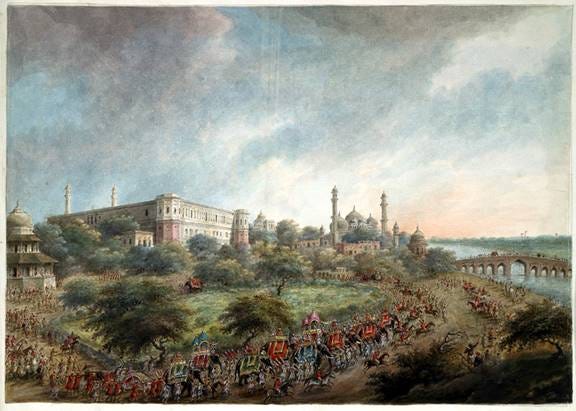
Rawdon proved to be less well suited to peacetime. Perhaps because of his introduction of native education and freedom of the press, Rawdon fell victim to accusations of appropriation of public funds and, embittered, he resigned and returned to England. He was completely exonerated, but his reputation and position had suffered in the process, and he had not the means to retire. As a result, he accepted a lesser posting as Governor of Malta in 1824 where he finished his career, dying on board a ship bound for Naples in 1826.
Although he had promised his wife that they should lie in the same grave, Rawdon was buried in Malta. Since at that time it was impossible to transport a body that distance, he had instructed that his right hand be amputated at his death and sent home, that it might eventually be buried with her. His wish was respected.

The mystery of the original settlers of Rawdon ! Quite the career the old boy had ! My only experience in Rawdon, was a below zero, winter week, in a un insulated summer cottage in Rawdon. As you recall, I worked at Shawbridge Boys Farm. Renovations were afoot,and housing was needed for 6 of the lads in our care. My close friend and co-worker, Eddy( Scottish/French parentage…like me) family, owned a cottage in Rawdon, where we ended up….what a memorable week !! B