Retribution

In the spring of 1821, George Hamilton learned that his brother William was judged to have lost the election held the previous year. The Assembly of Upper Canada had awarded the Prescott Russell riding to David Pattee in spite of all of George Hamilton’s dirty tricks.
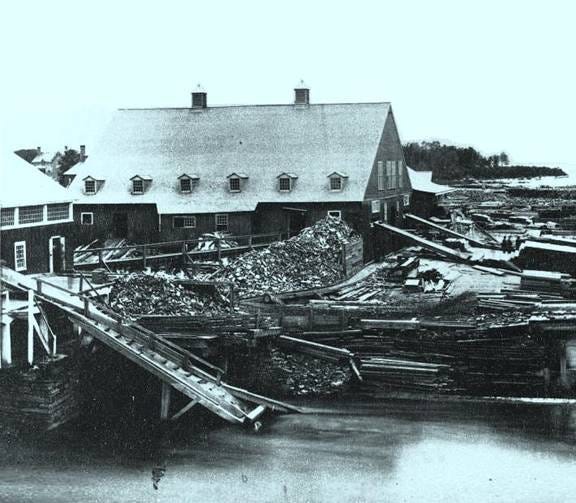
While it was a setback for the Hamiltons, the spring had brought with it a large supply of logs for their mill’s 40 saws and 80 employees. They took comfort in what they had achieved – some people claimed theirs was the largest operation of its kind in the world. George Hamilton’s ambition, to be the effective squire of the Hawkesbury region, was coming to fruition with an ever-increasing number of local families dependent upon his businesses. The next election was only three years away, and his star was rising. He would have to tread carefully, maybe completely abandon the illegal cutting his men were doing on Crown land, but their supply store had worked well in giving smaller loggers merchandise in exchange for their logs. His brother John ran their huge installation near Quebec City, dubbed New Liverpool Cove. It comprised over 2,000 feet of beaches, 450 acres of land and three houses, as well as work sheds, yards and wharves. His brother Robert presided over the firm Robert Hamilton, Brothers and Company in Liverpool, and they had become the recognized St. Lawrence River representative for underwriters in London, Aberdeen, Dundee and Liverpool. None of them had yet reached forty. They anticipated a great future.
In the meantime, the summer and autumn proved to be difficult as they learned that the British timber market was oversupplied. Robert made new arrangements, mortgaging all their properties to Gillespie, Moffatt and Company whose principal partners were in Montreal and London. They just had to sell their wood into a soft market, take their losses, and ride out the downturn. One year could change everything.
The following spring, 1822, also brought a large new supply of logs and the millpond was again full, ready to start the new season. There was even evidence that demand was picking up. George waited impatiently for the unusually heavy floodwaters to subside and for the first mail to arrive, giving him news from his brothers. As the spring brought its burden of ice water downstream towards his operations, the river rose to unprecedented levels and, breaking its customary banks, it carried away the millpond dam as he and his men watched, helpless. All their logs broke muddily into the main river and were gone.
This disaster was followed shortly by the arrival of the first mail boat, bringing the sad news to George that his brother Robert in Liverpool had passed away. The impact of the loss of the logs must quickly have faded in the face of this news, but George, father of three young children and one of the largest employers on the Ottawa River, had also to anticipate that their creditors would soon come, asking for full payment of the Hamilton mortgage, just as they, in their turn, had come to Thomas Mears and David Pattee only ten years earlier, confiscating their mill.
Among George’s closest friends was the reverend Joseph Abbott, father of the future prime minister, Sir John Abbott. The reverend told the story of the Hamilton trials and tribulations, comparing George to the biblical Job. While it is possible that his own vocation predisposed him to a certain exaggeration, the facts remain. He recounted the arrival of the mortgage demand and “[s]hortly after this, so immediately indeed, that I might almost literally say, ‘while the messenger was yet speaking,’ another arrived to tell him that his other brother [William] was dead.”
Showing a strength that seems the stuff of legends, George explained to his wife Susannah that they should prepare to move to Montreal with their three young children while he and his brother John negotiated a settlement. They would soon return, but even before they could finish packing up, their house caught fire. They had time to save themselves and watch. It also was a total loss.
On the day of their departure, the three children, living in a bubble of reassurances and comfort, laughing and playing, were seated with their parents in a large transport canoe guided stern and bow by capable Canadien canoeists. Reverend Abbott was present to see them off. He described the paddling songs echoing over the water as the canoe headed across and down the calm river to the first rapids. Getting through rapids, canoeists look for the deepest channel, sometimes breaking around rocks, sometimes spilling down over sudden drops. The river was a transport corridor and had been one for thousands of years. The men were experienced. They had done this many times themselves. This time, though, the bow canoeist, guiding them through the fast water, misjudged his paddle, which caught in a rock, and the canoe was immediately flipped into the rushing current.
In the water, George saw his 18-month-old son, whom he saved, just as they were both pulled tumbling through the rapids to the calm below. When he finally gathered his senses, he discovered he was no longer clutching the boy, who was gone. He spotted the two canoeists, clinging to the upside-down canoe, but no one else. Suzannah and the children were gone.
George swam towards the canoe and they slowly hauled it from the water. Underneath they discovered Suzannah, unconscious, clinging to a strut, but there was no sign of the children.
The good reverend Abbott told more: “‘All things shall work together for good for them that love God.’ And so they did in this instance; for my friend Hamilton was afterwards blessed with as fine a family of children as I ever saw…”