

Rooted in the Land
Thoughts on a press conference reaching out for us all to work together

On Tuesday, June 9, an exciting press conference was held in Ste. Agathe calling on us all to recognize the historical and current presence of Indigenous life in the MRC des Laurentides, and to build together. They were announcing the opening of points of interest that they are developing across the MRC.
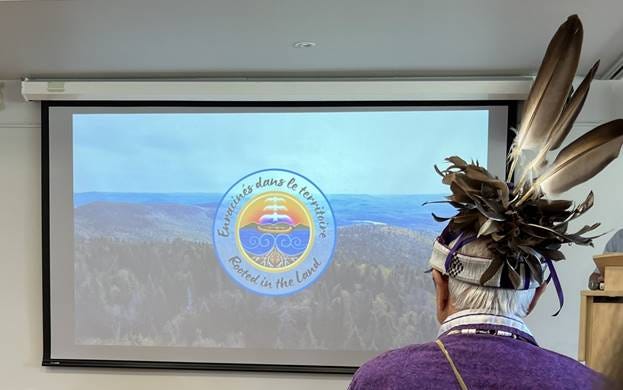
Hosted by Cherelle Parent of Vibrez au km2, there was a range of speakers representing the Indigenous communities, and the towns and organizations where the first points of interest are located, three of which are already open with the next two scheduled soon. The purpose, or objective, of the press conference is captured well in the MRC des Laurentides’ title for it, À la rencontre des Premiers Peuples, Meeting the First Peoples.
Kevin Deer of Kahnawake spoke first in Kanien’kéha (Mohawk) and then in English. His words evoked the Haudenosaunee Thanksgiving Address, Greetings to the Natural World, an acknowledgment of the land. This was not a settler’s land acknowledgement, but what the Haudenosaunee have always done to introduce important community events. He did not do the whole Address – it was not the place – but for those of us who know it, the message was clear. Importantly, his message closed with an urgent call for all of us to find our way, before it is too late.
Take the time to read the Address. Just enter Haudenosaunee Thanksgiving Address, Greetings to the Natural World in your browser or click on this link.
The speakers and the other people involved that I talked with afterwords encourage us to not assume that because we talked with one of them, we know them. They described themselves, after all, as First Peoples, not First People. There are many facets, Nations, language groups, and ways of living, but what makes the First Peoples a nameable group, then? Are there any general observations that can be made about First Peoples?
Before that question can be asked, perhaps we should start with who is asking it. The First Peoples generally accept the term Indigenous in that they all “came out of the ground” here, and everyone else did not. I put the term in quotes, because I first learned it from when Chief Canassatego, leader of the Onondaga Nation, addressed Thomas Bladen, the Governor of Maryland, at the Treaty of Lancaster in 1774. He was encouraging the governor and his confreres to accept that the Onondaga were their Elder Siblings, a weighted and meaningful term, and should be deferred to, listened to. The First Peoples, the Indigenous peoples, have a knowledge of the land and how it must be cared for that they offered to share. Their ethic was as a part of Mother Earth’s plan and they co-existed with their sister species, animal, plant and spirit. They have invited the non-Indigenous peoples to listen to them many times since Contact.
We, the non-Indigenous peoples, did not listen then. Why would we listen now? Many of the non-Indigenous people’s ancestors have been here for centuries. What differentiates the First Peoples? Why have they not joined the melting pot of Canada, the United States and other countries?
If we look at ourselves, know ourselves and what makes us different, we will find that our foundational ethic involves a concept of ownership, of property.
Indigenous Peoples have belonged here for millennia. They belong – they do not own. Many Indigenous Peoples throughout the world have always belonged, as a keystone species in a family of sibling species. The role has been to belong, praise, share and maintain.
Contrast that with ownership, with property as personal possession. It is simply the opposite.
That does not mean that non-Indigenous people cannot be good stewards. It does not mean any one is bad and the other good. Nor does it mean that people who see themselves as belonging cannot be radical and destructive.
I believe that indigeneity in some form was the way people were during the longest part of human existence, that during that time humans understood their place in the family of life and worked to fulfill our role, not as good stewards, a term that implies a separation, but as a keystone species. During a long period of our past, humans fulfilled a role that reinforced an understanding of belonging to a greater whole. I question whether what we have come to think of as progress and civilization is necessarily a higher form. It is just a different form, and it is also one that cannot find its place in the family of life but sees everything through a lens of property. There was a break with the past that probably happened many times and likely failed many times.
The largest break, the one that we are a part of, may have come with the herding cultures. Anke Becker of Harvard University makes the argument that herding was the origin of male dominance. Herding led to the protection of a mobile asset, the herd, and that led to property, to ownership. Anke Becker’s focus is on how it led to seeing women as the property of their men.
It also was a huge source of zoonotic diseases, illnesses that crossed the species barrier between the herded animals and their human herders. The diseases would lead to die-off among the herding peoples until their surviving descendants could co-exist with the diseases. They then became the carriers of those diseases. Through contact, their enemies and neighbours across Europe and Asia also experienced the die-off at contact with the herders, becoming culturally influenced by the victors of wars, but eventually their surviving descendants also followed suit, subsisting with the diseases and carrying the contagion. The process could have taken tens of thousands of years and involved huge population reductions over time, but eventually the resistance would be complete bringing with it new social norms that would have developed during those long periods.
When the descendants of these people met the non-herding peoples that we call Indigenous, cultures that had no sense of property – ownership – the spread of these new diseases in their communities was rapid and destructive. Most of the Americas was peopled by non-herding cultures but while they had no resistance to the diseases, their ethical foundation was ancient and unshakable.
These two conflicting value systems are both present, and to achieve reconciliation they need to find their balance point, to establish a new normal. We can only do so if we can learn to listen.
We are once again being invited to listen, and as Kevin Deer warns, time is short. Belonging to the land has existed since time immemorial whereas the concept of property ownership is relatively recent and, as we can see in our contemporary society, it leads to an unsustainable future. If we continue along this path we will experience a crash, a correction, possibly of huge magnitude.
On June 9, the Indigenous presentation included the introduction of Kina8at Ensemble, a non-profit that offers training, awareness-raising, and wellness programs inspired by First Nations philosophy and traditions. Dominique Rankin, an Anishinaabe Elder born in the bush of Northwestern Quebec and founder of Kina8at Ensemble, spoke to us in French and Anishinaabemowin on their vision: working together. As a survivor of the residential schools, he struggled to maintain his culture, and he explained to us that the word Anishinaabe simply means human being. As human beings all of our challenges are shared, and we can learn that we are all Anishinaabe. Rankin, the founder of Kina8at Ensemble invited all Anishinaabe – all human beings – to face our challenges together -- ensemble. He invited all Anishinaabe to join him at a future event, to climb Mont Tremblant together.
This press conference was only the most recent call out to us. Will we listen? Will we resolve to find that new balance point together, to climb that mountain together?
You are working to advance reconciliation and reciprocity Joseph. No higher praise can be given. Thank you.
So much food for thought and (hopefully) action in this remarkable essay.