

Rue Préfontaine, Ste. Agathe des Monts, Québec

The name Préfontaine has long been associated with Ste. Agathe, not just with the street, but also the area where Mount Sinai Hospital once stood.
Like many other people who influenced our town and left us a placename, the Préfontaines were Montrealers. They chose to vacation in Ste. Agathe and in the process became involved in the community. Joseph Raymond Fournier Préfontaine was born into a farming family in Lower Canada, or Canada East, in 1850. He attended Collège Ste-Marie and later studied law at McGill College. At 23, he was elected Mayor of Hochelaga, and two years later, in 1875, he ran and won a seat in the provincial Legislative Assembly for Chambly. Ambitious and active in many different areas, it is hard to imagine that he could adapt to the slow pace of the countryside.
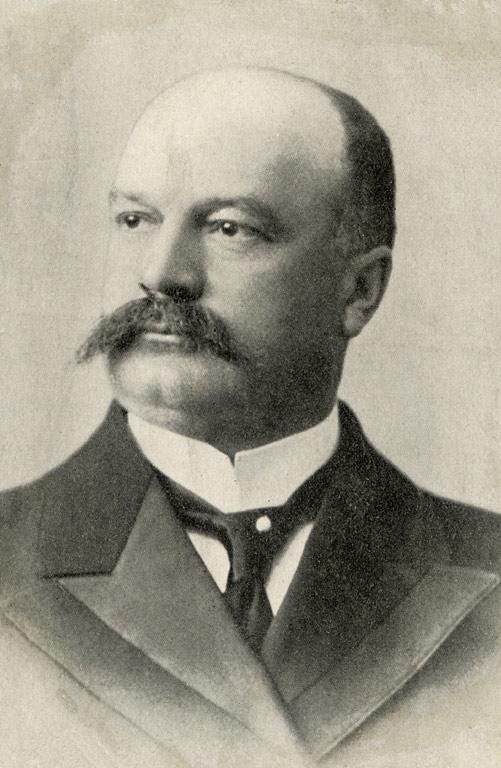
Préfontaine married Hermantine Rolland in 1876, and they suffered the loss of several children at birth. Only three of their children survived into adulthood. Driven by hard work, perhaps in part by these tragedies, he won a seat in the House of Commons in 1886 while maintaining an active law practice and serving the town of Hochelaga. Once Hochelaga was annexed, he served on the Montreal municipal council and subsequently became Mayor of Montreal in 1898. He also maintained seats in each federal election until 1905. He was a very popular federal politician, one of the favoured sons of French Canada, and someone who people felt was destined to become our prime minister.
From 1900 to 1902, Raymond Préfontaine, the Mayor of Montreal, was also the Member of Parliament for both Terrebonne and Maisonneuve ridings. He simultaneously held three political posts, any one of which would be perceived as a full-time responsibility today. Running for two or more seats in the House of Commons was not illegal until 1919. There was a House rule that said if a member won more than one seat, he should resign the extra seat or seats. But there was also a law that stated if your seat was being contested after the election, you could not resign until the challenge was resolved. In this way, MPs sometimes found themselves forbidden from resigning the seat that they did not want to keep. For a party leader, running in more than one riding made sense, but any candidate could do it.
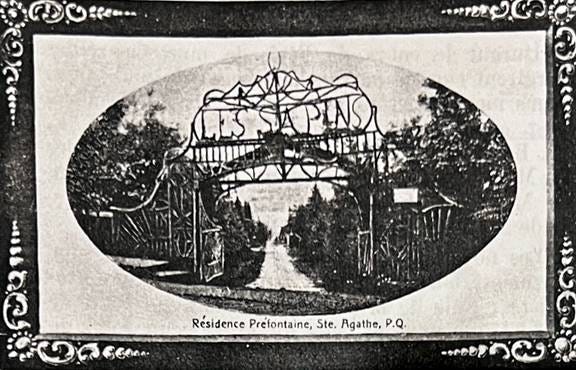
In 1893, the year after the train first arrived in Ste. Agathe, Préfontaine’s brother-in-law, Octavien Rolland, purchased the property known for the next 25 years as Rolland’s Point but now as Greenshields Point. Rolland, whose father founded Rolland Paper, and for whom Mont Rolland was named, must have received his sister and brother-in-law as houseguests many times. By 1899, Mr. Préfontaine had acquired a parcel of the Chalifoux farm and built a lovely summer house on Lac des Sables. It featured a tower and eyebrow dormers and was accessed through an ornate gate sporting the words ‘Les Sapins’ in a light arch of woven sticks above the entry. Located at 182 Tour du Lac, it has been renovated and restored many times and has always been the home of influential Montrealers. It evoked ease and relaxation, belying the lives of its occupants.
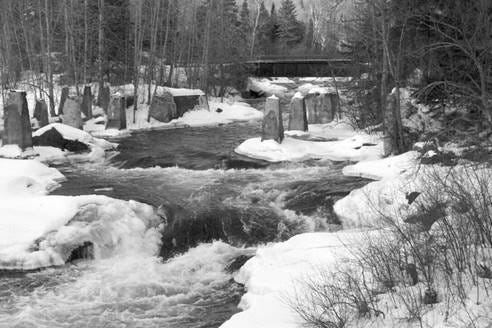
It did not take long for the Préfontaine family to get involved in the life of their adopted town. A year after the house was built, Rolland Préfontaine, an engineering student and the eldest son of Raymond and Hermantine, helped the Compagnie d’Aqueduc et de la force motrice des Laurentides design a hydroelectric facility on the North River in the area that we have called Préfontaine ever since. A year after that, around the time Préfontaine became the MP for Terrebonne, the village council decided to name various streets and install proper road signs. For the main entrance to the village, the road that ran from the location of the original railroad station up to Tour du Lac, they chose the name Rue Préfontaine. Virtually everyone coming to Ste. Agathe had to arrive by train, and their action served to remind all visitors of their affection for the honourable J.R.F. Préfontaine.
Aside from his legal practice and political responsibilities, Préfontaine sat on both the Catholic School Commission and the Harbour Commission of Montreal, was a director of the Société Saint-Jean-Baptiste, and a member of the Chamber of Commerce, the St. James Club and the Canadian Club of Montreal.
In 1902, he resigned both Terrebonne and Maisonneuve seats, as well as his post as Mayor of Montreal, and assumed the role of Minister of Marine and Fisheries. He was subsequently re-elected in Maisonneuve in a by-election and named to the Privy Council. In his role as minister, he travelled to France to negotiate a marine agreement. He also undertook the delicate mission of acquiring a wedding ring for his eldest son, Rolland, to bestow upon his future bride. Sadly, he suffered a heart attack in early December and died in Paris on Christmas Day, 1905. He was fifty-five. His funeral, held in Montreal late in January after his remains were returned on Queen Victoria’s private yacht, was one of the largest funerals Montreal had seen.

Short lived. Massive impact.
great article ....do we know who owns "les Sapins" now.?