


Up-North, particularly Val Morin and Lac Raymond, was our summer destination when I was a child, as it had been for my mother, Patricia Paré. When in late 1959, my mom became a young widow with six children, Val Morin, especially the winter and skiing, evoked the security she desperately needed. The next month, January 1960, she moved us to the Laurentians.
Mom had been a downhill and giant slalom ski champion in her late teens and early twenties. She won the Dominion Ladies’ Championship downhill race
at Banff, Alberta in 1937 and two years later she was the first woman to win the Kandahar, the first year that women could participate, but she learned how to ski only after that, when Hermann Gadner asked her if she wanted to learn to ski. She knew better than to walk away from the offer with a haughty rejection and so became the first woman to teach skiing in Canada. Thanks to him, her ski passion became teaching and she stopped racing.
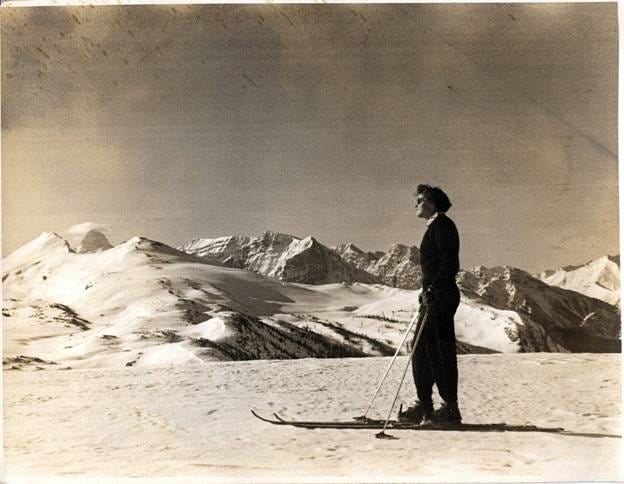
In 1961, Mom landed a job in skiing. Andy Hamilton, a semi-retired insurance broker, knew her by reputation and asked her to manage Summit Sauvage. It was a ski hill that was very close by – about a mile’s walk from where we lived at Lac Raymond.
Judging from the condition of the lift and the hill groomer, Summit Sauvage had been operating for years, and from 1961, skiing would become the focus of our lives. For those of us who grew up in the Laurentians during the 1950s and ’60s, there was always a small local ski hill nearby. It had begun a generation earlier when Alex Foster and Moïse Paquette independently invented the rope tow, one in Shawbridge and the other in Ste. Agathe. In her younger days, my mother skied up the hills before skiing down again and Jackrabbit Johannsen deplored the opportunity lost by being pulled up the hill.
Our school bus stopped not far from the ski hill. My new school, an English Catholic afterthought in the front of a chapel in Ste. Adele, had four classrooms, seven grades, and four intrepid Acadienne lay missionary teachers. The ski hill was much more interesting.
Mont Sauvage is an unusually high peak. It is in the south part of Val Morin and back then it had a fire tower up top. The tower was unmanned and climbing it was not for the queasy, but the view was magnificent, way above the treetops. We were told that our hill was the second-highest peak in the Laurentians, but people have also made the same claim about a few other hills. From the fire tower to the bottom of the slope represented only 60% of the height above the valley floor. Just across the old, meandering Route 11, now called Rue Morin, was Mont Belair, built by Alcide Belair when he saw that the chalet owners were coming for the winter holidays. He had a rope tow at first – boy did it go fast! To maintain his privacy in the summer, he left his bull to graze alone on the slopes.
My mother had advised her employer that Summit Sauvage needed a beginner’s trail. He authorized her to cut one. She did. It was narrow, safe-ish and a mile long. She didn’t actually run the machines, but she walked, marked the trail’s path and oversaw the work. We were often with her on that project, a wonderful life for an eleven-year-old. I learned about the narrowness and safeness the following winter because it was the only place I ever caught my pole while going as fast as I could. That hurt, but no-one ever knew because there was no-one else around. A real beginner, though, would never have had the opportunity to pick up speed on that run.
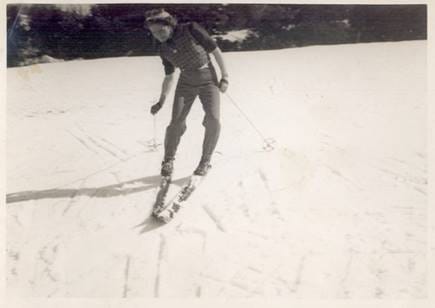
There was a T-bar and grooming equipment, probably things that a more mechanical person would have considered as important. My Mom was going to learn fast.
When the season began, we had the hill to ourselves – us and our cousins and friends. There was some marketing, but it was not a high-profile place and there were many small competing ski hills. We all had to be available if Mom needed us though, like the day a major storm dumped over a foot of new snow and the grooming equipment groaned, coughed and stopped. It promised to be an excellent ski weekend if the trails could be groomed.
Mom called on her kids, a slew of nieces and nephews, and friends. She had taught most of us how to ski. The lift was fine, so our job was to go up to the top, form lines and pack the trails all the way down. It was one of the most exciting ski days of my youth. The conditions were incredible. After packing for a bit, we each skied down, caught the lift back up, skied to where we had packed, and continued work. I suspect that all of us who were there that weekend still remember. By eleven, the hill was a skier’s dream – lightly packed powder. Mom knew skiing.
In the course of time, we met the mechanical guy, Pete Gilmore. He was huge and always greasy but that didn’t help things work. He taught us all we needed to know about guiding clients into the right position and putting the T-bar under their bums while he puzzled away to keep the machines going or took the groomer apart trying to get it started.
We all have stories of our early days of skiing, regardless of the hill. Our ski equipment was minimal. I had low-profile lace boots and wooden skis with a harness that trapped the toe-end of my boot in and relied on a cable behind my ankle to keep it there. I skied so far forward that I didn’t really need the cable. I remember once skiing at Mont Castor, a similar-sized hill in Ste. Agathe. I flew over the wooden jump and, landing flat on my skis watched as both harnesses popped open. It made no difference. I skied to the bottom before even bothering to check them. Those same skis and harnesses could be used for cross-country by releasing the cable from a clip on the side of the boot.
For me, and many like me, those were the magic years of downhill skiing. To get an extra run in on a good day, we would forfeit our lifts home and ski along back roads, sliding along snowbanks, sometimes for miles, depending on which ski hill we were leaving. When the taller boots came, I felt like I was in a cast instead of a ski boot. I gave it up and stuck to trails through the woods.
Another winner. Thankyou.
A magical childhood