

St. Andrews Mills
Following the lead of Thomas Mears, the Ottawa Valley mechanizes

Major Patrick Murray, who fought for the British in the American War of Independence and became the commandant of Fort Detroit during the 1780s, purchased the seigneurie of Argenteuil in 1793. Seigneuries, dating from the French Regime, were used to colonize regions. The owner, who looked actively for settlers, was bound to supply the basics, and made an income by leasing farmland for homesteading. After the French Regime, it was not uncommon for wealthy or well-connected people to acquire seigneuries, promote colonization and reap the benefits.
Pierre Panet, the seigneur who sold to Murray, accepted to defer a part of the purchase price. While the repayment schedule was reasonable, Murray lacked the necessary experience to develop the property and soon faced insolvency. His son, James, who some sources claim rescued the seigneurie from creditors in 1803, was influential in its subsequent development but while the seigneurie developed rapidly, their tenure was never stable. They named the village of St. Andrews, reflecting their Scottish influences, and worked hard to develop it, while up the North River a ways they sold a large parcel to Jedediah Lane of Jericho, Vermont, compromising their seigneurial rights over that parcel for a quick payment.
Needing to improve services to his tenant farmers and assure their trade, Murray sought expertise in New England to help him harness the North River and build a gristmill in St. Andrews. The new United States was not the land of opportunity that we are told it was. This was the period of Shay’s Rebellion, when thousands of Massachusetts farmers, many of whom were forced to become soldiers and then never paid for their services, rebelled because the wealthy Boston elite was taking their farms for back taxes. The army crushed the resistance, and the courts showed no mercy. One of the Founding Fathers, Samuel Adams, a willing participant in the suspension of habeas corpus in this event, declared, “In monarchy, the crime of treason may admit to being pardoned or lightly punished, but the man who dares rebel against the laws of a republic ought to suffer death.” By contrast, the Ottawa Valley, opening for settlement in the wealthy, powerful British Empire, attracted many young New Englanders.
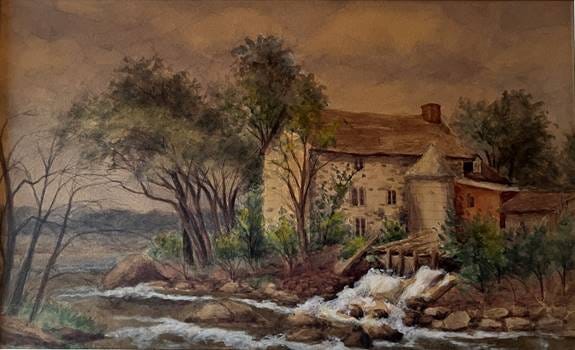
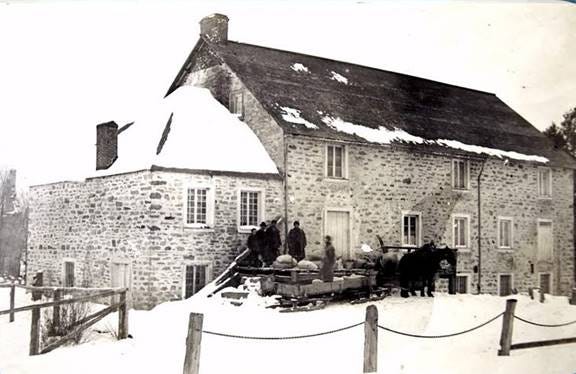
Murray found Thomas Mears, a hydraulics engineer and willing emigrant, who dammed the North River and helped him design and build the mill in 1794. Stories of Mears’s work brought more young Americans to St. Andrews. Headed by Walter Ware, whose father operated a mill in Massachusetts, they negotiated a lease with the seigneur and built another mill almost directly across the river from the gristmill. It would become Canada’s first paper mill.
In order to make the mill viable, Ware contracted with James Brown, a bookbinder and printer in Montreal, to sell the mill’s paper products. By 1806, only a year after the mill had begun producing, Brown, whose properties would grow to include the Montreal Gazette, became a minor shareholder in the mill. He was a man who initiated an uncountable number of litigations as though he cultivated the law to bulldoze his way forward. After taking Ware to court for not respecting their contract, he bought out the balance of the shares in 1810 and moved to St. Andrews to run the mill himself.
The balance of Brown’s working career became more focussed on the mill and, in spite of his Montreal operations’ apparent success, by 1822 he had sold both the Gazette and his Montreal business to concentrate on the mill. He moved into an expanding area of hard-working, risk-taking immigrants. Village-sized rafts of logs floated down the Ottawa, guided by the currents and the efforts of the crews who lived on board, as gangs of Irish, Canadiens, Maritimers and Scots, some farmers and others desperate for any kind of employment, chopped away uncomprehendingly at the ancient Algonquin forests, cultivated and celebrated by a civilization that had lived in harmony with its environment. The Ottawa River, once called the Grand, that for centuries had accommodated the meeting, gifting, fishing and hunting communities of the Indigenous cultures, was deteriorating into a sewer, converted into a new kind of commercial-industrial culture whose relationship was one of exploitation, of taking but not of sustaining. The new paradigm was not the rotation of the seasons but the status of the individual. Fortunes were won and lost, and anyone could be the winner or the loser.
In 1807, the Murrays once again faced insolvency and lost the seigneurie through a sheriff’s sale. Sir John Johnson, legendary for his family’s relationships with the Indigenous communities, acquired the seigneurie, and the Murrays seem to have faded from the historical record. The impact of this change on Brown was the Johnsons’ refusal to renew the litigious Walter Ware’s original lease when it came due in 1834, building a mill for the farmers across the river during that same period.
Although not necessarily the best adapted to the farming that was developing along the valleys on both sides of the river, entrepreneurial American immigrants were becoming the most numerous of the new arrivals. Equipped with Yankee know-how and nerve, they brought new ideas and techniques into the valley. Thomas Mears, among the better educated, and not needed in St. Andrews once the mills were built, followed the pattern of acquiring land for farming but, transfixed by a fast-flowing channel on the far side of the river identified on the old French map as Chennail écarté, he had other things in mind.
