

Stealing Deals
Continuing adventures on the Ottawa River

Late in the year 1811, as winter set in, Thomas Mears and David Pattee were obliged to sign over the mill they had built together at Snye Carty. They had mortgaged it to have the means to supply an order of ‘deals,’ milled planks used in shipbuilding. The financing came from the same source as the order for the wood, Hamilton Brothers, near Quebec City.
From the Hamilton perspective, Mears and Pattee were up-country lumberers, naïve country boys. The Hamiltons, with their operations in Liverpool and London, were more aware of the changing circumstances in the main British market and thought themselves to be socially superior. Smaller operators like Pattee and Mears would often depend upon financing that was based on the supply of a certain product by a certain date, although not necessarily from the client they were supplying. The creditor might capitalize on late delivery by insisting on a penalty but would not want to suffocate the supplier by actually taking possession of his business. After all, everyone has his own expertise. It came as a cold, hard punch to learn that the Hamiltons were not interested in a penalty but would exercise their mortgage. It was business, and even banks still do it in our time where they see a profit to be made. Pattee and Mears watched as their years of effort and risk were stolen.
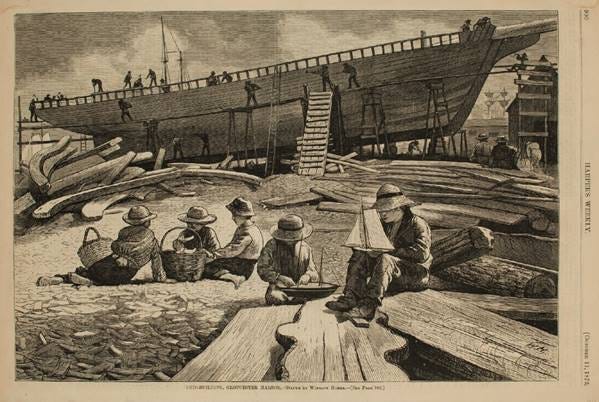
The British government introduced preferential duties, protecting the timber trade in the colonies in 1808, in large part because they had become more dependent upon their colonies and needed to assure their supply. France had successfully threatened the British navy by blockading the Baltic where the pines used for shipbuilding grew. A worldwide search for other sources led to the remaining forests of their North American colonies.
The Hamiltons saw the advantages of the preferential duty and capitalized on it. They could not have wished for a better outcome than the default of small players like Pattee and Mears. The mill closed for the winter of 1811-12 and nothing changed in Snye Carty until April 20, when the river was running ice-free again. Then a suspicious fire wiped out the mill and all the stock. The Hamiltons would have to start again from the beginning, just as their upcountry predecessors had done.
There is no proof that the fire was set deliberately other than the insinuation that it was suspicious. While a loyal employee of Pattee and Mears might have been more zealous than negligent, it is unlikely Pattee or Mears would have been involved. They had too much to lose. In 1812, Thomas Mears was elected to represent Prescott in the Upper Canada Assembly and Pattee went back to his successful farm. He did not venture into lumbering again, but Mears, from his new mill in Grenville, remained a serious competitor to the Hamiltons, who faced a large financial and technical challenge to rebuild the mill. William Hamilton came out to Snye Carty first, but he wanted to retire, and his brother George soon took his place. They had two other brothers, one, John, who stayed at the wharf in Quebec; the other, Robert, was head of their firm in Liverpool, and it was through him that their operations were financed. In Snye Carty, there was no love lost between the two factions, Hamiltons on the one side and Mears-Pattee on the other.
In 1816, Pattee was named a Justice of the Peace and a Surrogate Court judge, while Mears became District Sheriff. Simultaneously, George Hamilton was also named a Justice of the Peace and an Ottawa Court Judge as well as co-commissioner with the seigneur, Joseph Papineau, for the improvement of water communications on the Ottawa and St. Lawrence rivers.
The two factions represented very different backgrounds. The Hamiltons, whose friends included some of the staunchest members of the Family Compact, saw themselves as overlords, seigneurs – a class above the commoners. Most of the population was either French Canadian or American, with some Scottish farmers and Irish working-class people. To the Hamiltons, democracy was a radical, even distasteful, idea. The upper class was the only one capable of guiding society and should benefit from the responsibility of class. The Assembly was a place for controlling patronage, but its power should remain advisory only, deferring to the governor and his appointed executive council.
The two Americans were from the republican, democratic United States. Most of these Americans were highly suspect given the tensions that brought about the War of 1812. An oath of allegiance would not suffice to reassure people like George Hamilton.
With the approach of the Assembly election of 1820, Mears backed the nomination of his highly respected friend, David Pattee, while George Hamilton convinced his brother William to come out of retirement to be honoured as their member. Pattee was much more popular. He would carry the whole American immigrant community as well as much of the working-class. At the same time, the Hamiltons were still in desperate financial shape. Their plans had not included rebuilding the mill and they were facing their own creditors. To keep afloat, they were illegally cutting trees in Crown timber reserves, an action that left them vulnerable to Mears, the sheriff. George had his work cut out.
George leaned heavily on his friend Joseph Fortune, the returning officer. He also began a campaign of intimidation, threats and even violence to assure himself the necessary votes to see his brother win over Pattee. There was no secret ballot, and the voting took place publicly over several weeks. Down and dirty, George dug up an old accusation dating back to 1803 in New Hampshire. Pattee had been charged with forging banknotes in a case that was never resolved. Even with the mudslinging, Pattee received the majority of votes and would have been declared the winner if Joseph Fortune had not been the one counting them.
It's hard to believe the past was even more criminal than the present, eh?