

Terrebonne
Setting the tempo for Canada

As a by-election approaches in Terrebonne, I watch with interest. Canada began one stormy spring day there in 1841 when the first prime minister of the province of Canada set our patient tempo for governance.
Louis-Hippolyte Lafontaine trudged through the mud of a spring thaw on a March day in 1841. He and his supporters were in good spirits. Lafontaine had been their Terrebonne member in the Assembly for two terms before the rebellion. He had rejected violence and had broken with his Patriote party over it, but it mattered little when the Assembly was dismissed in 1837.
The new governor, Charles Edward Poulett Thomson, had won no-one’s affection. The story going around was that he had been sent to force the two colonies, Lower and Upper Canada, to unite by whatever means he deemed necessary as long as he followed the recommendations of Lord Durham and went through the motions of respecting the constitutional rights the Crown had accorded both colonies. In Lower Canada he named a special council of 100 men to vote on the motion that he knew would be unpopular, and he worried that even this select group might object. He chose an early winter storm in 1839 to convoke them, giving little notice. Only fifteen braved the weather.
He chose well. He could bully and threaten a small group. The idea of uniting the two colonies was not new and it had been resisted since it was first raised in the 1820s. Few people understood Lord Durham’s reasoning when he presented his report to the government in London. Nicknamed Radical Jack, he hoped to solve the local problems by showing people that they could stand up to the elite British controllers known as the Family Compact in Upper Canada and the Chateau Clique in Lower Canada. These groups did what they could to get Durham recalled – he was not on their side. He had the time, though, to study the situation. He had to get some of the leaders of the rebellion out of the colony before they called for their hanging. He succeeded in saving them, but he had enemies back in England too, who got him recalled on the grounds that he overstepped his jurisdiction in sending them to Jamaica and other British colonies.
Durham saw that the two colonies were distinct. Upper Canada was much smaller and the elites and the middle class were largely of British or British-American descent.
Lower Canada was much larger. He summed up his observation of Lower Canada this way. “I found two nations warring in the bosom of a single state. I found a struggle, not of principles, but of races; and I perceived that it would be idle to attempt any amelioration of laws or institutions, until we could first succeed in terminating the deadly animosity that now separates the inhabitants of Lower Canada into the hostile divisions of French and English.” He saw that Upper Canada had an experienced middle class, but in Lower Canada, the differences had become defined around ethnicity. Even though there were wealthy, successful French businessmen, the Chateau Clique didn’t want them. The British and British-Americans among the middle class were a minority and they broke down into two groups, one that made common cause with the Patriotes and other reformers and one that assumed it was part of the elite because it wasn’t French. It was not a healthy situation.
Thomson was promised a lordship if he could get Durham’s recommendations through – though he didn’t need to understand their intent. Once he was finished getting his stormy night endorsement from Lower Canada, he moved on to York (Toronto) to get the same endorsement from Upper Canada. He did not expect them to bargain, but their terms would still allow him to show he had united the two colonies. The deal he accepted was that Upper Canada would have the same weight, the same number of seats in the new assembly as Lower Canada would have. The two colonies would become the Province of Canada, or the province of Canada East and Canada West and Thomson would get his title. His next task was to hold an election that would show that the majority of the newly elected assembly supported his executive council. He knew what to do.
As Lafontaine and his supporters trudged through the mud to the small English settlement of New Glasgow, they confronted a gang of English thugs blocking their passage. Lafontaine understood. Elections were not all held on the same day and there were no secret ballots. It was a rowdy affair, and Lafontaine knew that even an appeal to the military to disperse them would be ignored as it had been elsewhere. Lafontaine knew that this was another trick of Thomson’s. He saw his supporters sizing up the thugs and preparing for a fight. He knew some would be killed and he knew the court would not be with them.
Lafontaine withdrew his candidacy and led his supporters away.
The news carried the story that Lafontaine had been defeated in Terrebonne.
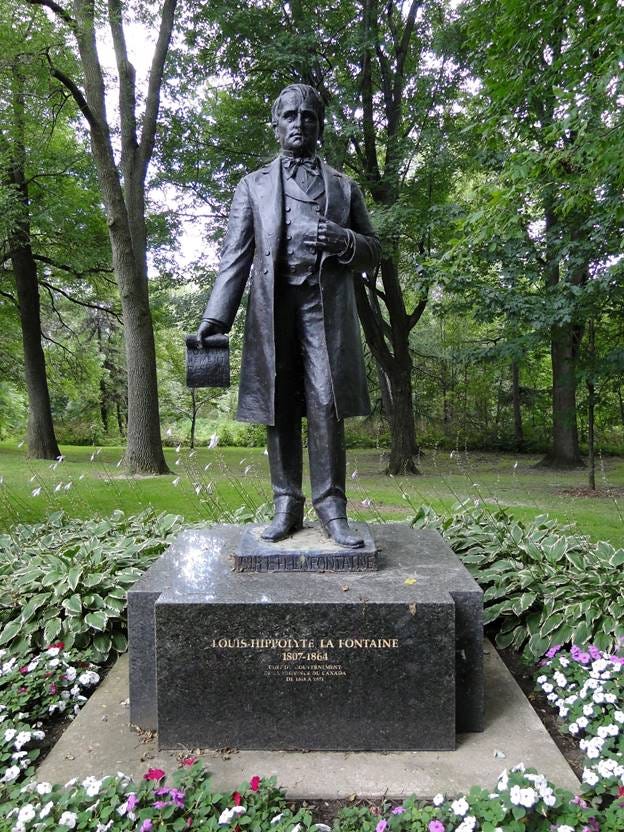
Lafontaine, though, had been working with Robert Baldwin in Canada West. Baldwin led a party of reformers who had reached out to Lafontaine and his party to stand together against the elites.
A generation earlier, two great men had seen and understood the rule of law that was embedded in the constitution of 1791. They saw that it gave them rights, but that they were going to have to fight for them. One of these men was Pierre Stanslaus Bédard, a lawyer, founder of the Parti Canadien and the newspaper that carried the same name. The other was William Warren Baldwin, a medical doctor and lawyer who had arrived in York in 1799 with his family. Bédard’s political party became le Parti des Patriotes, and Baldwin groomed his son Robert to pursue the values that could challenge the Family Compact. Robert Baldwin and Lafontaine had opted to work together against Thomson and his plans to hold the assembly to a consultative body only, reporting to his executive council. The two men consulted with William Warren who offered to stand aside and propose that Lafontaine run in his York riding.
Thomson had accepted to fulfil Durham’s recommendations that included the possibility that the assembly, acting in majority, could form a responsible government. Accepting did not mean that he believed, and he needed the Tories, those conservative members who would accept their advisory role to the Executive Council, confirming the governor’s dominant position in the colony.
The assembly represented the people and were the ones responsible for raising taxes to finance the running of the colony. They, like the Patriotes before them, objected to collecting the taxes with only an advisory role in the government. Responsible government meant that they should administer too. If the Assembly were to elect a majority of members who agreed with them, then they would form not just an advisory group but a government responsible for administering the taxes they collected. Lafontaine’s and Baldwin’s joint objective was to obtain that majority.
Charles Edward Poulett Thomson achieved his goal and became Lord Sydenham, but even with illegal, heavy, sometimes violent interference with the 1841 election, he created a stormy, unstable assembly that he could not control. Compounded by an unsustainable pace of trying to manipulate the assembly, he had a riding accident that left him with an infection leading to lockjaw and he died in mid September.
From his defeat in Terrebonne in 1841 at the hands of Thomson’s bullies, it took Lafontaine along with Baldwin seven years to achieve their goal of responsible government. Louis-Hippolyte Lafontaine became our first prime minister in 1848 in what was then called the Province of Canada.