

The Ghost of the Ottawa

As a hydraulics engineer, Thomas Mears had worked on the design of several mills, including the paper mill at St. Andrews and the original mill that the Hamiltons had taken from him and David Pattee at Hawkesbury. In 1816, looking for a new project to champion, he partnered in the construction of a steamboat that would be able to climb the rapids at Vaudreuil. Mears hoped to be the first to establish a steamboat service on the Ottawa River.
Steamboats were coming into more common usage. The first Canadian one, put into service by the Molsons, was the Accommodation, travelling between Montreal and Quebec City. Even the engine parts were homemade, coming from the Forges du St. Maurice near Trois Rivières, the oldest blast furnace in North America, dating back to the French regime. The engine was only 6 horsepower and the boat was a business failure, but that did not stop the age of steam in Canada, or the Molsons. Their next boat, the Swiftsure, had a much more powerful engine built by Boulton and Watt in Great Britain; most of the boats built in Montreal during the decade ending in 1820 used imported engines.
Thomas Mears and his partners did not import their engine but instead relied on one of their partners, Joseph Lough, to build it. They started by helping Lough set up a proper furnace. Over the next three years, Lough proved incapable of managing his business and several of the partners withdrew. Mears, who had moved to Montreal, returned to Hawkesbury and all but abandoned the project. By 1819, though, Lough had lost his stake and a new controlling partner resurrected the project, bringing Lough back in on the basis of a strict contract. He also made a deal with John Bruce, a shipbuilder who had worked for the Molsons, building their first steamboat in 1809. One of the new partner’s conditions was that the boat itself be built under the auspices of Mears in Hawkesbury. Dubbed the Ottawa, the boat was finished on schedule and floated down to Montreal to be outfitted with Lough’s steam engine. True to form, Lough fell so far behind schedule that they lost the first summer and had only enough time to try the boat out in the autumn, just before winter set in. The trial, held on Lake St. Louis in mid-October, caused a sensation. The side-wheeler was considered attractive, the engine was Canadian-built, and the boat ran at around 10 miles per hour. Things looked promising for the Ottawa for the1820 season, but there was a concern. With her engine onboard, she had a draft of three and a half feet, which would make it unlikely she would ever be able to climb the rapids. She might never make it back to Hawkesbury.
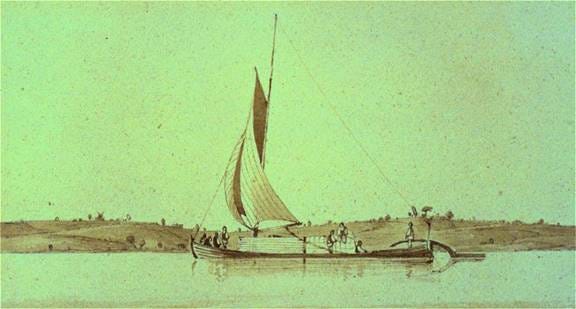
Sure enough, even during the high water of spring, the Ottawa was beaten by the Ottawa. Seventy feet long, twenty wide and with a hold of four and a half feet, she sat three and a half feet below the waterline. Her captain, William McMaster, took her out on an unrecorded spring day to find her way up into Lake of Two Mountains but discovered there was only a depth of three feet for a long portion of the passage between the lakes. Still, she became the toast of Lake St. Louis that summer, proudly running a circuit from Lachine to the Cascades and transferring passengers to more suitable batteaux and Durham boats, large, sturdy, flat-bottomed boats with a bow-like point at both ends as though inspired by canoes. If the boat turned around, it made little difference. They could be poled or towed up the rapids to calm water or float high on the current going down or they could hoist a sail to travel along a stretch of river.
While the summer proved exciting for passengers and even for sightseers, and real estate promoters began to claim that the steamboat made up-river property much more valuable, the owners saw things differently. The Ottawa was not paying her way. When Captain McMaster “jumped ship” in the fall to partner in the building of a rival boat better designed to climb between the lakes, the partners saw their Ottawa as a liability and put her up for sale. The auction took place in May of 1821, but after the bidding, one of the backers, Alexander Allison, ended up as the sole owner and continued to offer the boat for sale until his untimely death in December. His estate took over the next spring and sold the boat in parts, leaving only the hull on the shore at the entrance to the Lachine Canal. She sat on the river bottom in the spring but broke the surface as the summer water level dropped, suffering the indignity of serving as a dock.
Meanwhile, the Perseverance, the new boat in which Captain McMaster had partnered, succeeded in getting up the rapids at Vaudreuil. She did so only once, at great expense, then returned to Lake St. Louis, where she basked in the glory of her defeated rival’s old routes.
Thomas Mears did not let go of his dream of having a steamboat on the Ottawa, though. He had quietly acquired the steam engine from the Allison estate and had it carried up to Hawkesbury and installed in the Union, the first steamboat to offer regular service on the Ottawa River. She first sailed in the spring of 1823 between Grenville and Gatineau.
A few years later, in 1827, a heavily laden Durham boat, the Louisa, heading down the St. Lawrence from Kingston and riding high on the spring flood, mastered all the shallows and rapids including the legendary 82-foot drop between Lake St. Francis and Lake St. Louis. Approaching the Lachine Canal, all her worries behind her, a vindictive old ghost ripped her apart as she glided serenely over the abandoned hull of the Ottawa.