


In the 1980s, Ste. Agathe boasted a mayor whose name was Marcel Larocque. He lived on Rue Larocque so the name seemed appropriate, and newly arrived people often assumed that the street had been named for him. The truth behind the naming of that quiet street running up between the Catholic church and the cemetery is tied to the history of the continent.
The first people to claim a lot in the township that would eventually become the Parish of Ste. Agathe arrived in 1849, and only three years later, in 1852, the elderly doctor in St. Jerome decided that he, too, wanted some land there. He had found wealth and adventure in far-away California where he experienced the gold rush.
In 1848, the American government annexed California from Mexico in an act of aggression that brought the American army into Mexico City. Mexico’s failure to respond to an offer to purchase presented three years earlier was followed by American sabre-rattling and “the most unjust war ever undertaken by a stronger nation against a weaker one.” [General Ulysses S. Grant speaking to American Press, early 1850s. His claim has more competition today.] Mexico was forced to accept a lower offer, bringing the coveted territory into American possession. Having acquired California and New Mexico for the Union at great cost, President James Polk was faced with a large, viable coastal region that could become a thorn in America’s side. It was a wealthy territory, and he used that wealth to his advantage when he announced the discovery of gold on December 5, 1848, setting off a veritable invasion of fortune-seekers, a mob of people that overwhelmed any political resistance that the current residents could have mustered against the unjust war.
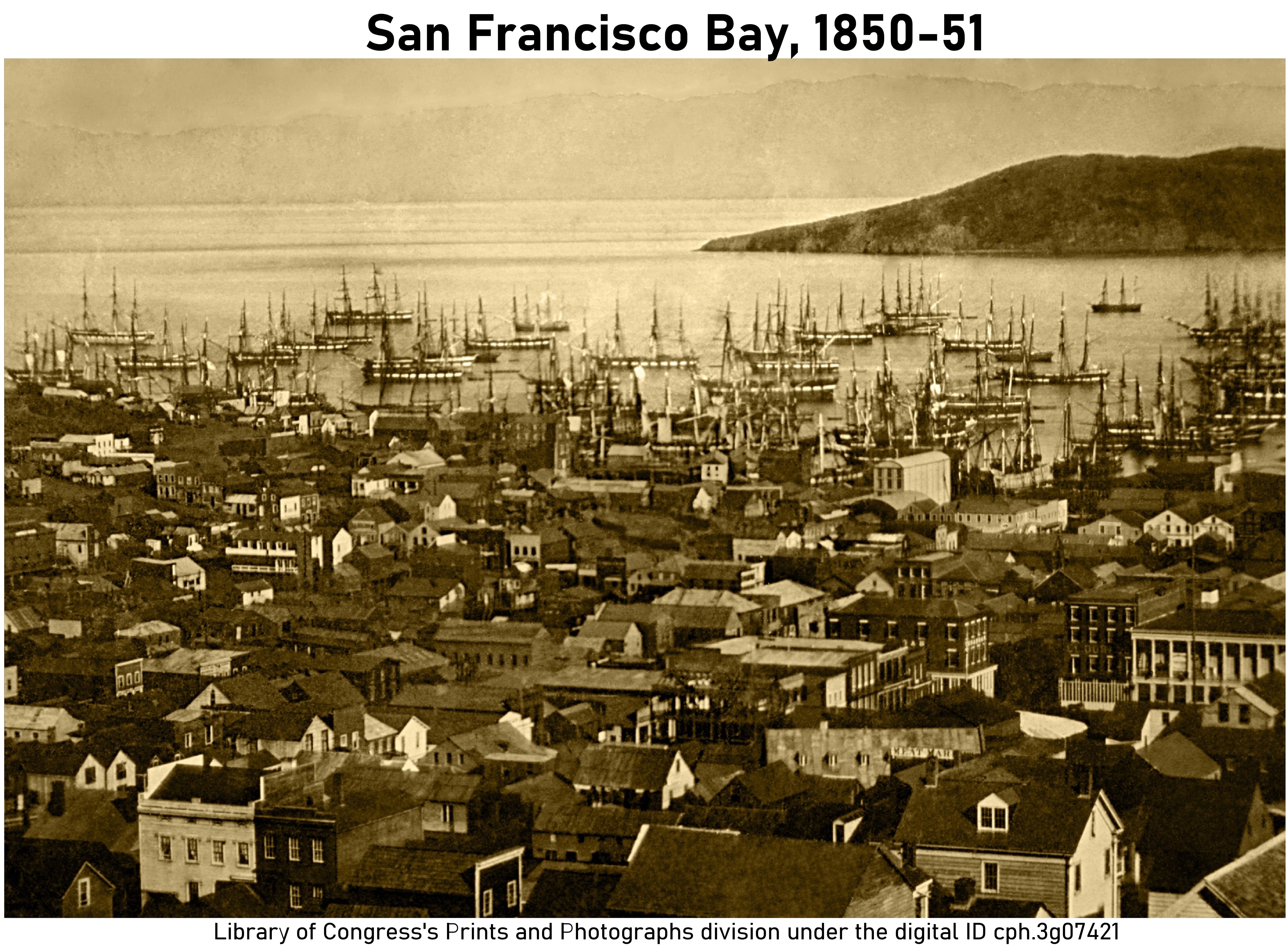
The newcomers were dubbed the Forty-Niners.
The Gold Rush was the catalyst that grew California rapidly into statehood. Between 1848 and 1855, three hundred thousand people arrived there, coming by land and by sea. Even residents of San Francisco, a town of about a thousand souls, took to the hills in search of the gold, but the new population squatted where they could, including in newly arrived ships. The town grew to a population of 25,000 in only two years. The timing of the gold rush is reminiscent of a classic American bubble, coming as it did towards the end of a recession. People arrived from all parts of the world, half of them via the sea.
We don’t know how or why Dr. Luc Eusèbe Larocque had travelled, but he was likely already there in 1848. Imagine the stories he would have had to share. If he was a Forty-Niner, he would have had to travel either along the California Trail, a journey by foot or horse over 3,000 km, or via ship around the southern tip of South America, onboard for five months, or possibly even through the jungle of Panama for a week with the hope of catching a ship on the west side.
Whenever Larocque arrived, as a doctor his services were in high demand. There was no shortage of patients. It is estimated that one in twelve of the miners died violently or through accidents as the countryside descended into lawlessness. Successful miners would have bid high for his services, pressing gold nuggets gratefully into his hands.
The mob turned on the visible minority immigrant communities, and bandits ruled. The native American population, one of the richest, most diverse in North America, fell victim to this lawlessness and racism as its population plummeted from 150,000 to 30,000 by 1870.
Success became known as the California Dream, and many see this period as the time of the birth of what we have come to call the American Dream. The rapid expansion set the United States into a new gear, gaining speed ever since. Before Larocque left, the Fugitive Slave Act was passed in the United States, and black slaves were finding security in the British colonies. The United States was looking a lot like it does now. In 1854, a compromise to deal with racism called the Kansas-Nebraska Act turned violent and Kansas became known as Bleeding Kansas. The tension grew and by 1860 the secessions started. The concept of a Canadian federation to stand against the chaos soon began to form as slaves found their way to freedom here.
Somehow, Dr. Larocque got home safely to St. Jerome where he could afford to retire. He decided to buy land in the new township of Beresford, now called Ste. Agathe, and to rent it out to farmers. It was not a well-conceived business plan since the neighbouring farms were available directly from the government and could be acquired simply through homesteading. Even so, Larocque pursued his dream of living quietly from his imagined farm revenues. He did what he knew best how to do – he treated the sick. When his tenants failed to pay, he recognized that the stress was unhealthy and he did not insist. His patients produced no gold nuggets, but even so he responded positively to a request to donate a parcel of his land for a church. Slowly, lovingly, Dr. Larocque’s California Dream was spent on the welfare of the souls in his care in the hills around Ste. Agathe.
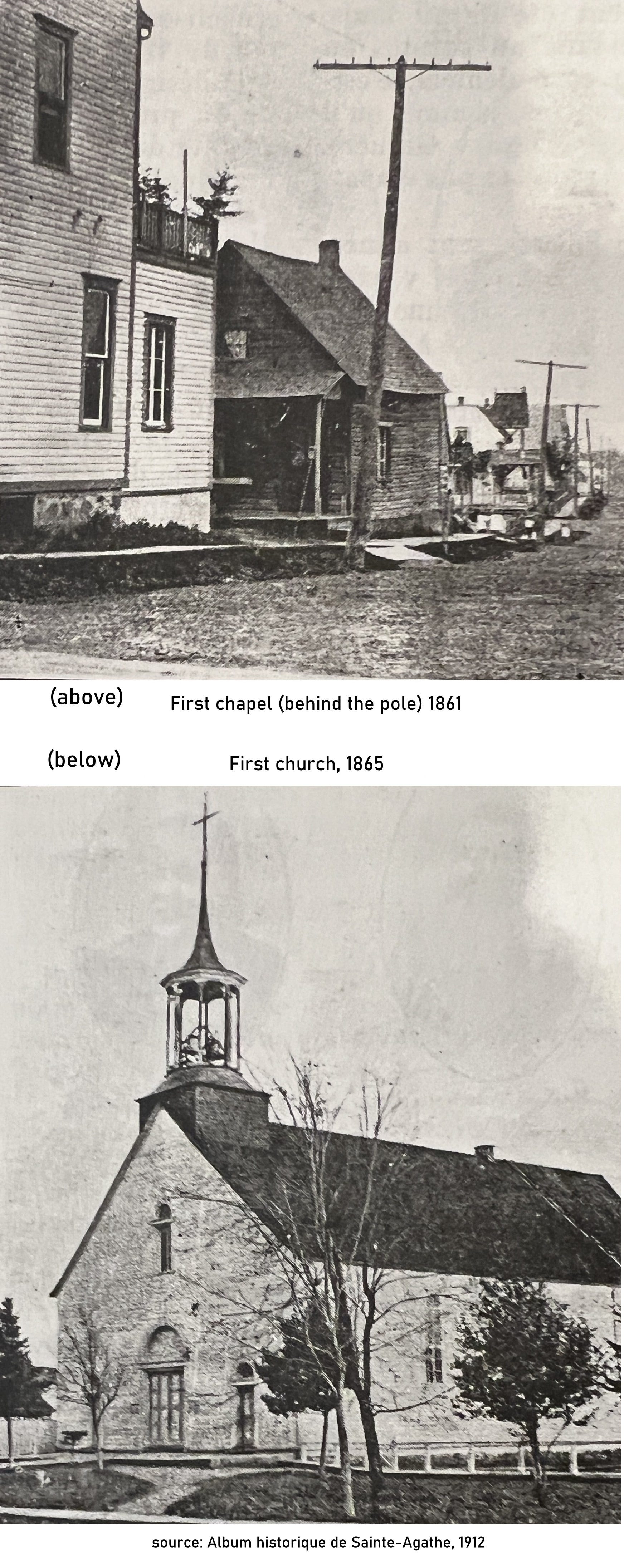
Mrs. Larocque, Louise De Montigny, did not share his passion for the remote, rocky hills that could be reached only by a long march over trails. The good doctor did his best to convince her, coming up every summer and sending her poems describing the beauty that he discovered, but she skilfully parried with oil paintings that she claimed were inspired by his verse. When they passed away, his heirs sold the balance of his holdings and their daughter became the custodian of their art and poetry, but neither that legacy nor any of his own stories of his experiences in California can be found.
All that is left is the quiet street running between the church and the cemetery in Ste. Agathe.
Great story-telling and inspiring because it actually happened. five-stars
Fascinating and terrifying that "plus ça change, plus c'est la même chose!