

The Village of Cushing, Quebec

Sometimes researching place names leads to stories that justify a choice and instill pride in the people who live there. Sometimes the research can also lead to other branches of a family that were a part of another story the family did not take pains to promote.
Lemuel Cushing arrived in Chatham in 1822. He was 16 years old and looking for work. He grew up in Trois Rivières and Montreal, but his first work experience was a short apprenticeship with cousins in Peacham, Vermont. Years before, while living in Trois Rivières, his elder brother Hezekiel had been given a horse and $5.00 and told to find his relatives in Peacham, travelling in some cases through trackless forest. Hezekiel, who was only twelve, had accomplished this task before Lemuel was born. He had gone on to serve the British in the War of 1812, and he became a successful farmer in Rigaud. He was an inspiration and a hard act to follow for the young Lemuel.
Lemuel’s father, Job, moved his family to Montreal when Lemuel was eight, and the story of his brother faded into the background as he learned his new life. It was not until his father died seven years later that he considered following his brother’s path. He travelled to Peacham to learn the lessons that had served his brother so well. His stay was short because many young men were leaving Vermont to find work in the rapidly developing Ottawa Valley. Within a year, he was headed back north and facing a new challenge.
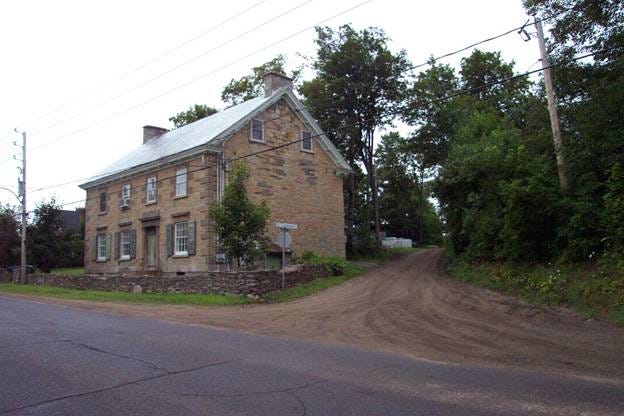
In Chatham, Lemuel soon found work in lumbering, and within a short time saw an angle that would allow him to work as a middleman. He managed to parlay his profits into a stable business and was among the most important citizens in Chatham by the time he was 25 years old. To accomplish this task, he traded in shillings, louis, dollars, promissory notes and barter, purchasing and selling in Montreal and wherever else he could while keeping inventory in those pre-electronic days with well organized, hand-written ledgers. His store, built in stone somewhere between the late 1820s and the mid 1830s, survives today. Lemuel married Catherine Hutchins of Lachute in 1836, just before the ‘Troubles.’ The Troubles of 1837 and 1838, also called the Patriot Rebellion and the 1837 Insurrection, are much romanticized today, but at the time they tore society apart, especially in rural areas where the issues were often interpreted around local divisions, pitting the French inhabitants of the seigneuries against English and other immigrant homesteaders. Cushing supplied arms for a militia and led a party of men to St. Eustache, where they saw action in the aftermath of the uprising, stopping rowdy armed men from pillaging, and saving the local records at St. Benoit. Dependent upon good, clear ledgers, it is not surprising that Cushing could appreciate the value of the registry of those documents.
The Cushing family boasted a military tradition on both sides of the border. His grandfather, Job Cushing Sr., rose to the rank of Colonel in the American War of Independence, and fortuitously passed away before his grandson, Lemuel’s much older brother, fought the Americans in the War of 1812. Lemuel’s role in the Patriot Rebellion would have given him pause. The patriots, after all, were inspired in large part by Thomas Jefferson and the other Founding Fathers of the United States. Colonel Job Cushing had served with Benedict Arnold, but he had not joined Arnold when the latter changed sides. In fact, it must have been difficult for an American war hero of that time to see two of his sons move to a British colony. We can speculate on why Lemuel’s father had left the United States. His uncle Elmer, the most colourful family member at the time, could well have been the cause.
The Cushing family, including 5 children, moved from Hingham, Norfolk, England in 1638, and all ended their lives in Hingham, Plymouth, Massachusetts. The coincidence of the Hingham placenames suggests they had a strong influence, and the Cushing name has risen to prominence many times throughout American history. Lemuel Cushing, for whom Cushing, Quebec is named, was one of these Cushings of stature. He acquired the famous Caledonia Springs resort in Ontario, some 20 km west of Hawkesbury and bought an island in Portland, Maine, where he built the Ottawa House. He held important civic positions in Chatham and his son, also Lemuel Cushing, a respected lawyer, served briefly as member for Argenteuil in the federal parliament. But how his branch of the family became Canadian is a story that leads to another, much different placename story.
Elmer Cushing came to Montreal not as a Loyalist, but more as a young man seeking opportunity. Montreal was a boomtown in the period after American independence. This was the time that Molson’s Brewery and other all-Canadian enterprises began, and the city, flooded with immigrants, many from the United States, was rapidly growing and changing to fulfill its new role as the largest British city in North America. Elmer set up a hostel called the American Coffee House. While he had some success with it, he soon found that he had grown too fast and was in debt to what he called the ‘Gentlemen of the City.’ Around this same time, he received a visitor. David Mc’Lane was an American who solicited Elmer Cushing’s cooperation to set up a safe house for an advance party who declared that they intended to recapture the colony for France.
From Mc’Lane’s point of view, Cushing must have looked like a fair bet. He was an American, son of a hero of the American Revolutionary War, and could have been judged a sympathizer with such an American-French plot. He was down on his luck, being seriously in debt to members of the British elite, and owned an establishment called the American Coffee House. Mc’Lane was wrong. Was David Mc’Lane really a spy, sent to prepare for an invasion, or was he just a big talker? The invasion never happened. Is it because the colonial authorities were tipped off? Was it nipped in the bud, or did Mc’Lane fall victim to a very nervous and paranoid administration?
Cushing lost the American Coffee House to his creditors, but in a peculiar twist the colonial authority awarded him Shipton Township, an area of 58,692 acres. Was it compensation for service to the Crown in turning a spy in?
The English business elite at that time had no idea how the Canadiens would react to such an invasion, and they lived in an atmosphere of fear and insecurity. The rebels who led the American War of Independence had already tried to capture Canada, and that without the French flag waving at the head of their troops. To add to their concerns, the French were actively trying to get Louisiana back from the Spanish and were supporting Jefferson for president with the understanding that the Americans would help them invade and retake New France. Stephen Sewell, the younger brother of the Attorney General, Jonathan Sewell, was convinced that Citizen Pierre-Auguste Adet, the French representative to the American government, had already secretly visited Montreal in preparation for the eventual invasion.
Looking back, it is possible that Mc’Lane was associated with people who were planning an invasion, but it is also possible that he was just a braggart. In his memoirs published in Stanstead in 1826, Elmer Cushing went to great lengths to explain that he would not participate in any such scheme and declared that he told Mc’Lane so right up front. He records a long, chiding speech that he made to Mc’Lane, pointed enough to warn Mc’Lane to get out of the colony if he really was an agent of an organised movement.
To be continued…