

Weir, Quebec

Names often recall an individual, or an event but sometimes they describe a feature or an action like Saskatchewan, from Cris kishiskadjiwan, meaning rapid current, or the original name for St. Faustin, La Repousse, that means it pushes you back.
Most Canadians are familiar with the story of Wolfe and Montcalm, the two generals who died in the battle of the Plains of Abraham. In the Laurentians, though, Montcalm didn’t die but lived on to defeat…Weir. It is this second, less well-known debacle that has brought us back to re-examine the history of the naming of Weir and Montcalm.
The names of towns and villages come from many different sources, including the names of mill owners and post offices, but there are also the names that the Ministry of Colonisation assigned to different regions as they developed. In the Laurentians, these regions, called cantons in French and townships in English, often carry names that commemorate Great Britain and its colonies in the nineteenth century. Beresford, Abercrombie, Howard and Rawdon come to mind, as well as the townships of Montcalm and Wolfe, sitting side by side but originally accessible by totally different routes. Imagine a little committee choosing these names. What guided them? Did they wish to re-enact old battles? The name Wolfe was given to a region settled originally by French Catholics, while Montcalm started off with both English-speaking Protestants and French Catholics. Wolfe had the little village of La Repousse, and Montcalm had …Weir. La Repousse’s name described an action, to push you back. It came from the steep hill that one had to climb to perhaps the highest elevation of any settlement in the Laurentians. Had English Protestants settled the region, they may have been comfortable with the township’s name, but French Catholics were unlikely to have embraced the name of the man who had defeated Montcalm so instead, they listened to what the place did. It pushed back. The Church didn’t think much of that name, so they named the new parish after a forgotten Christian martyr from Roman times, St. Faustin. It has recently returned to something the place also does and is now called Mont Blanc, for its ski-hill.
The origins of the name of Weir may not have represented an English Protestant challenge to the prospect of living in Montcalm but who knows the secret motivations of the person or committee that chose it? In a long-ago discussion with a resident expert on the history of Weir, Claudette Smith-Pilon, she told me that she believed the name Weir originated back somewhere in the last half of the 1800s. In her searches, she met a fellow named Stéphane Sigouin who owned a house that once belonged to the Duncan family, and that he had found building material in his walls with the stamped name and date: Weir, 1857, or 1887; the print was smudged. The Duncan family owned a mill and at one time they were the major employers in the region. It is possible that they made materials for use in housing, although Smith-Pilon suggested that the stamp should more likely be associated with Northland Lumber, another company that had established itself the area. Whoever created the stamp, the name Weir associated with such early dates has brought people living there to ask who Weir was.
Most people seem to agree that Weir’s name came from William Alexander Weir, MLA for Argenteuil and also Superior Court judge for the district of Pontiac. He was born in Montreal in 1858. Obviously if the stamp actually dates from 1857 – or even 1887 – there would have had to be another, older Weir. The judge would have turned 29 when the building material Stéphane Sigouin found was originally stamped. Neither the Duncan Mill nor the village called Weir even existed in 1857.
According to the Commission de Toponymie, the township of Montcalm received settlers as early as 1853 and was proclaimed in 1857. It had several different villages, including Weir, which began to be settled in the mid 1870s. It could be argued that the Weir stamp commemorates the year that the township was proclaimed, but Weir was not the township’s name. Let’s suppose that the date on the stamp was 1887. They would have to find a different, older Weir, and modern amateur historians have accommodated by proposing one. According to Basil Kerr and Bevan Jones, in The History of Weir, Judge Weir was the son of a general who had served in the War of 1812 and was subsequently asked to open up the Weir territory for settlement. I could not find a general named Weir associated with the War of 1812. Judge Weir’s father, however, arrived from Scotland in 1852, so a General Weir would have had to be, at best, a more distant relative. In any case, we have found no records of this older Weir, but Kerr and Jones also mention that it had a previous name, Saginaw.
To further muddy the water, C. Thomas’s history of Argenteuil, published in 1896, states under the heading Montcalm, “This Township, which is of recent formation is not mentioned in the list of Municipalities in the Province of Quebec, published by the Government in 1886.” That would suggest that it may have been considered a part of another region and may have even been proclaimed under another name. Thomas makes no reference at all to a settlement called Weir, and Thomas was writing in English for a local English readership.
We know that there was a Municipality of the Township of Montcalm, and that there was a village, a hamlet named Weir in the township. The Commission de Toponymie also tells us that the municipality of the township was first called Harrington and Union and that the township changed its name officially to the Municipality of the Township of Montcalm in 1907. The township was huge, and it comprised a few little settlements, but Weir was only one of them, and while Weir was mostly English speaking, there were a lot of French Catholics up and down the range roads. The Montfort Colonization Railroad ran through Weir in 1897, and they helped things out by calling the station Weir. The post office in the village of Weir was established with that name in 1904, and the post office that originally serviced Montcalm changed its name to Sixteen Island Lake in 1898.
One can imagine that the residents of this township would begin to feel a little confused, losing their Montcalm post office to Sixteen Island Lake, then getting a new one named Weir in a small hamlet where there was already a train station with the same name, then establishing the name Montcalm for the municipality of the township. Since the township was a political entity and Weir was only a post office and a railroad station, both beyond local control, a lot of residents of Weir began to feel under siege after 1907. Should the railroad station or the post office close, the importance of the name Weir would be reduced. Already there was no political justification for the name, and the old English families were not replenishing themselves. In 1962, the worst happened; CN, which had purchased the line in 1924, closed the Weir station.
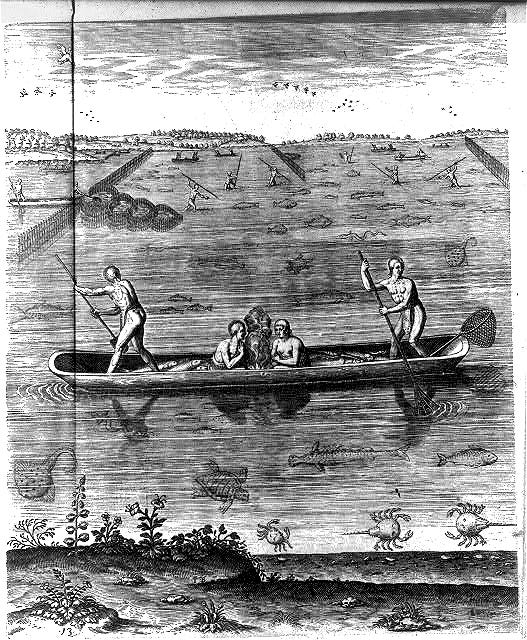
We have to go back a few steps and look at Weir’s earlier name, Saginaw. This is a name with the same root as Saguenay and Saguay, both referring to the outlets of rivers and a place to install a … fishing weir. There is only a three-foot elevation difference between Lac Rond and Beaven Lake, but Lac Rond is surrounded by high hills and is fed from another small mountain lake as well as streams, so the winding stream leading to Beaven Lake may have been an excellent place for a fishing weir. Stephen Jakes Beaven, for whom Beaven Lake is named, set himself up on the outlet of Beaven Lake in order to trade with the Weskarinis Algonquin who would regularly travel along the Rouge River where Beaven Lake ultimately drains. It is a longish detour to visit a trader, but a reliable fish supply on the slow-moving creek at the inlet from Lac Rond may have been an incentive and a good reason for Beaven to have located there instead of on the Rouge River. Maybe the name is much older than the English settlers could have imagined. Maybe that fish supply had reliably fed people for a thousand years.
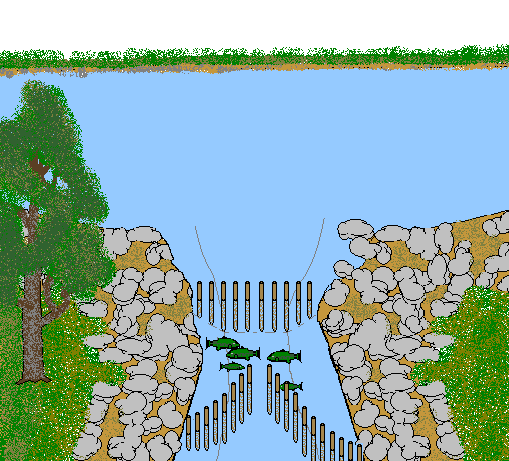
Weir held out for a further thirty years but was finally overwhelmed in 1992 when the municipal council voted to change the name from the Municipality of the Township of Montcalm to simply ‘Municipality of Montcalm.’ It took a further 12 years for Canada Post to change the name of the post office from Weir to Montcalm.
The weary warriors of Weir have all but capitulated, but they should take heart that they held out for a lot longer than General Montcalm and his forces did in 1759, and that they lost to a formidable bureaucratic adversary that could have stymied General Wolfe. If their name choice was taken from the Algonquin usage of their waterway, though, they could have just kept the name Saginaw and saved themselves a lot of questions about the Weirs.
Special thanks to Claudette Smith-Pilon of Weir, (or Montcalm, or Saginaw).
Hey Joseph…interesting read. I (do) believe, when my Dad was at medical school at the Univ De Montreal 1942-45,and dating my mom ( he met her when he assisted, as an intern, taking out her appendix…another story..)…that they travelled by train for a romantic summer week-end in Weir ! Thanks again…love this history ! B