

The Levines of Trout Lake

Each family has a claim to a rich past, the knowledge of which often dies with the oldest members. This lost knowledge is more than a personal family recollection of little relevance to those outside the family. It is a perspective upon the past of our culture and a part of the history of Canada. There are rich rewards for those of us who take the time to talk with the elders and write down what we learn.
Alter and Sima Levine arrived in Montreal in 1903 along with their seven children. They met others here who, like them, had fled the pogroms in Russia. Their new country was full of hope and freedom. There was no dark authoritarian presence watching their moves. There were no pogroms, random massacres of Jews, and the immigrants could freely share their stories, hopes and fears. Almost drunk with a sense of freedom, a number of these new Canadians decided to establish a commune off in the countryside where they could farm and reorganise their world. In Russia, it was illegal for Jews to be farmers. Many lived in the Pale of Settlement, rural territories where their security was always at risk from any powerful group that happened by looking for young men to serve in the military, or just to see what they could take.
What could challenge their vision in this new land where only hard work stood between them and their ideals? Small groups in our society were beginning to experiment with the ideas of Karl Marx and intellectuals everywhere believed that we could achieve utopia simply with a social system. One of these groups decided to test the concepts of Marx and Engels on a farm they could reach from the railroad in Ste. Agathe.
The family names of these social pioneers are still with us today: Ofner, Gillitz, Corn, Shuldiner, Smith, and a family by the name of Levine who were too numerous to join the commune but managed to acquire a separate farm nearby. These communists believed that they could create a new society in Les Cantons du Nord, the great north, where functioning farms with open, grazed fields could be purchased reasonably. The purchase price of the farms in Ste. Agathe should have been warning enough that their project was ill starred. Unlike the Canadiens, who had walked through almost uncharted woodlands and hacked down and burned the forest, these new pioneers arrived by train and beheld rolling, green fields, fenced pastures and roads.
Bucolic and practically free, the stony fields soon revealed their dark secrets. The soil is generally nutrient-poor and very thin, sitting on glacially compacted rocky gravel leaving crops vulnerable to drought even while small lakes and brooks shimmered in the hot sun. The frost-free season was short: It was unlikely to freeze between the 12th of June and the 1st of September, a period of only 80 days, but it had seen flurries in late August. While they could not rely on the weather in summer, watching helplessly as crops baked in dry fields or froze before they could be harvested, they could count on being stranded for days at a time in the heavy snows of mid- to late winter and would watch the thaw turn to torrents in the spring, cutting through roads as the snows rushed away for the season. The commune lasted less than five years.
Sir Mortimer Davis, a successful Jewish tobacco magnate whose own family came from England and who had a large private estate in Ste. Agathe, had extended interest-free credit to the commune through the Baron de Hirsh Institute. He ended up with the unpleasant task of taking the farm over when the young communists failed to repay their loan. Most of them had abandoned the commune, and Davis turned it over to a doctor, helping him set up Mount Sinai Hospital for the treatment of tuberculosis. Alter Levine, who was older than the commune members, had acquired his own farm on a lake nearby. He could not leave so easily. While he had wanted to be near the commune, he had a whole family to feed. Now with eight children, they must have practically formed a commune themselves. Alter and Sima had fled Russia to protect one of their children from the authorities. Either he was fleeing the death-sentence of military service or he had joined an illegal organisation that was protesting the Czar’s government. The latter could explain the family’s desire to live near the commune. Alter fell into a deep depression after the commune’s failure. Instead of heading the family and diligently farming, he became a suicidal burden. Sima, his wife, assigned her sixteen-year-old son Leo the task of checking up on his father to make sure that, in his depressed state, he did himself no harm. One day, Leo cut his father down from the rafters of the barn where the elder Levine had tried to hang himself. Another time he found his father bleeding in the woods and dragged him home, helping his mother nurse him back to health. Leo always remembered what his father told him while he was healing: “Next time you won’t find me.”
Sophie Levine Gross, the youngest and their only child born in Canada, remembered the hardships of those early days. She had no memory of her father. He made good on his promise and his body was never found. Her mother, Sima Levine, was left with 8 children ranging in age from 25 to 2 who, with her, were learning the local languages. They had fifteen acres of field under cultivation, a barn, a horse, a small herd of cattle and 50 chickens. Sophie’s earliest memories included receiving a new birth certificate because the farmhouse burned down and all their papers were lost.
Sima Levine of Trout Lake, the widow of Alter, must have been built of iron. After her husband had made good on his promise to kill himself somewhere around 1910, she carried on with her 8 children, farming their small holding. Leo, a tough, tiny man, was heavily burdened by his failure to stop his father’s suicide. He became distant from his family even though Sima did her best to encourage him. She entrusted him with the funds to cover their fire insurance, but we will never really know what he did with that money. Fire was a constant danger in those days. There was no safe heating source, and the structures were made from wood that dried thoroughly in walls that let the wind through during the long, cold winters. Everyone had experience with fires. Chimneys, stoves and fuels were not standardised, and daily chores occupied all of people’s time.
Never fully forgiven for the fire, Leo struck out on his own, farming next door to his mother and siblings. Sima, with her other children, slowly rebuilt the house. She also began to take in boarders, people who were visiting family at Mount Sinai Hospital, or others who had come to Ste. Agathe for the tuberculosis rest cure and could not find room at the hospital. Over time, their home evolved into the Trout Lake Inn and her sons ran it together with their mother. The inn was on the north side of the lake and became a popular destination, finally bringing the family some prosperity.
As Sima’s other children grew up, they found other ways of making a living. Ste. Agathe had become a prosperous destination and there was work in different services and willing employers. It is likely that the Inn could not support them all, in any case, and the Trout Lake Inn closed. What happened to Sima as she aged is not recorded.
Leo was the only one to continue farming. He built some cabins for rental to enhance his income, too. The town was booming from tourism. He met a woman a little smaller than he was and fell in love. She, who had the same name as Leo’s youngest sister Sophie, was one of the Eidlows, a Montreal family who holidayed in the area. Sophie Eidlow was forbidden from seeing Leo. He was certainly looked down upon, a small-time farmer from the sticks. She deserved better. Her parents found her a successful Montreal dentist who would be able to look after her every need. Feigning acquiescence, she accepted to marry the man her parents chose and asked for their honeymoon to be at Trout Lake. According to stories revolving around them, when the groom picked her up to carry her over the threshold of their honeymoon cabin, he shoved the door open with his foot and there found Leo sitting with a shotgun on his lap.
Leo and Sophie, both blackballed, made up in determination what they lacked in resources. They provided farm produce and rooms for guests, many who first came simply to visit family members at the hospital. Over time, they created Sun Valley Lodge, a popular resort, and found other opportunities to make money. When Sir Mortimer Davis died in 1927, his estate was liquidated, and Leo purchased a number of the outbuildings, dragging them behind a team of horses around Lac des Sables and over the hill to set them on foundations on his farm. These houses were rented to his guests for longer periods and in time were sold to them as summer cottages. Because the road ran along the lakeshore, they were placed up the hill, overlooking the lake, and the Levines kept a very deep setback of land between the road and the cottages. Rumours were rife that the government was going to widen the road and they wanted to receive the expropriation money. Thwarting their plans, a new road was built behind the mountain, eventually becoming the Route 117 that we know today.
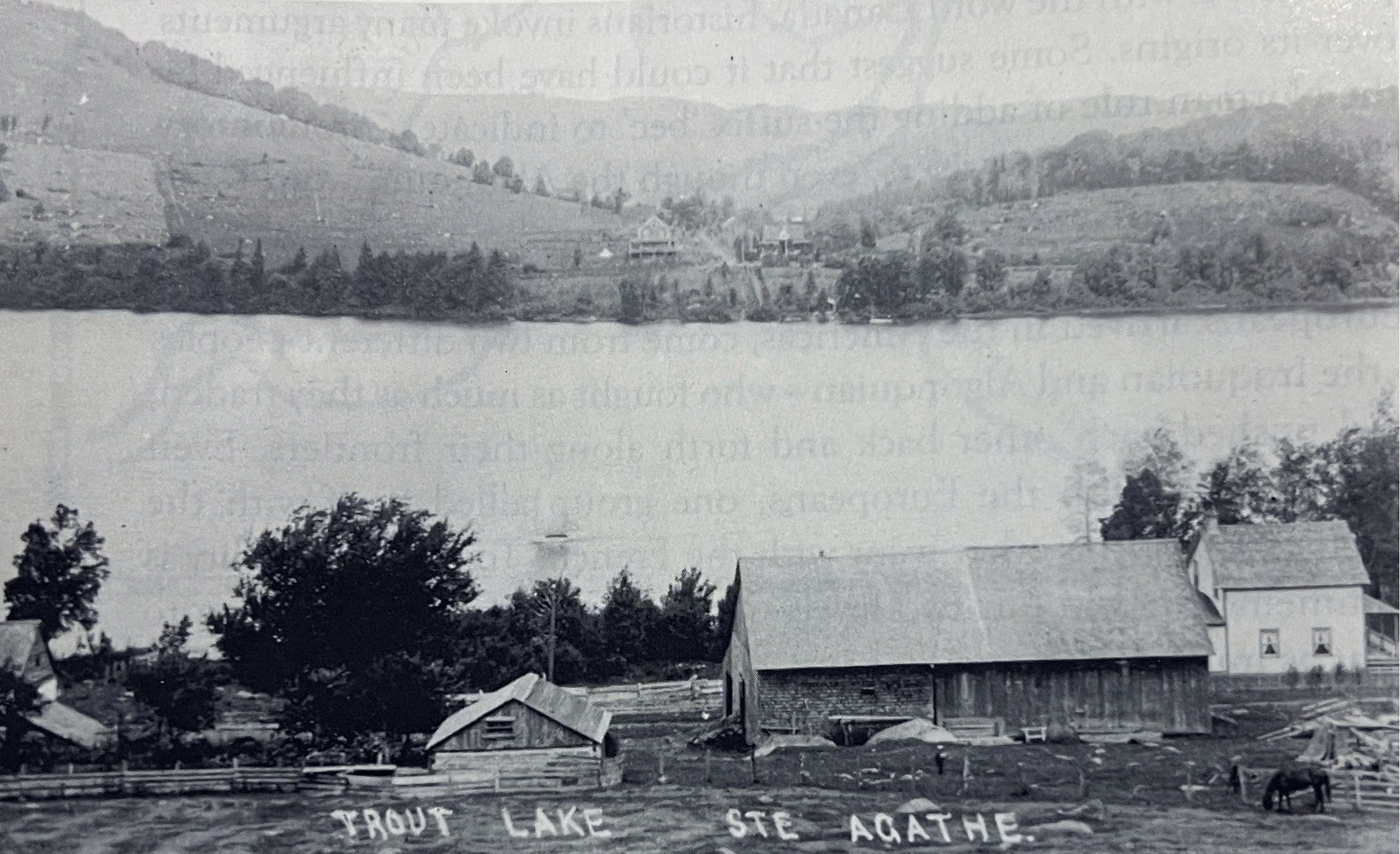
Unfortunately for the Levines the fields could no longer produce, being filled with cottages, and, with most of their customers preferring the idea of renting or buying a small cottage, the hotel became redundant. Undaunted, the Levines set up a summer camp for the many children. They themselves had one son whom Sophie home-schooled, telling everyone that her ‘Sonny’ would one day become a brain surgeon.
The Levine farm grew into the small Jewish country community that still exists around Trout Lake. While all of the other Levines moved away, establishing careers in the town or further, Leo and Sophie persisted. Eventually they sold the balance of the mountain, the grazing area above their once-productive fields, to the Gentemens who created Chanteclair Estates, a development based on Swiss chalets, all with views looking over Leo’s fields, and all sharing his beach on the lake. Leo told anyone who would listen that the mountain had been stolen from him. Predeceased by Sophie, Leo passed away in 1989 at the Mount Sinai Hospital, a tough little man to the end of his ninety-nine years. He and Sophie were survived by their son, Dr. Mark (Sonny) Levine, a neurologist having fulfilled his mother’s ambition. Together with his wife, three children and nine grandchildren, they lived in California.
The community that grew up on their farm consists largely of city people who came to Trout Lake for a variety of reasons, the dream of a commune long forgotten.
I loved reading this story. History is more colourful than fiction!! Since we spent our summers in the area, I could relate perfectly. Did one of the Levine's have a bakery and deliver freshly baked treats daily in a truck to the beach where we swam every afternoon? I remember delicious jelly donuts.
Amazing story, great research as always. Thanks, Joe!