

The Village of Cushing, Quebec Part 2

This is a continuation of the story of the Village of Cushing, Quebec. Between 1881 and 1905, long after this story took place, Lemuel Cushing’s descendants added Elmer Cushing to the extensive genealogy of the Cushing family, charting their ancestors’ arrival in Hingham, Massachusetts in 1638, but charts and lists cannot record the victories and failures of individual lives. To Lemuel Cushing and his large family, Elmer was a little-known eccentric uncle.
Elmer Cushing sought out Stephen Sewell to tell him about David Mc’Lane’s claim that he was an agent of a plan through which France would take back the colony from the British, and that the Americans were helping in the plot. Sewell took the story very seriously. Sewell’s older brother Jonathan, the Attorney General, was also the chief prosecutor. While his legal work has been highly praised in most cases, and he is credited with reducing the incidence of capital punishment, in the case of Mc’Lane, he acted vigorously, not simply to get a conviction, but to make a public example of the would-be traitor. Leading up to the trial in Quebec City in July 1797, Sewell and the authorities were dealing with riots over a law that obliged the Canadiens to contribute their time, equipment and teams of horses towards the construction of roads. Also, they were refusing to join militias for fear of being posted far from home. The riots were non-violent and probably would be considered more as strike protests today. The prosecutor collected evidence that Mc’Lane had a connection to Citizen Adet, a minister assigned by the new revolutionary government of France to develop relationships with the United States with a view to rebuilding Franco-American relations. That Revolutionary France may have been plotting to retake their New France colony struck fear into the hearts of the British and could not be ignored. With these tensions and talk of spies and an imminent invasion, someone like Mc’Lane, with no family or community to rally to his cause locally, was the perfect scapegoat. A conviction would allow the authorities to demonstrate what they could do if people did not fall into line.
William Barnard and John Black came forward as witnesses for the Crown. Barnard testified under oath that he had met Mc’Lane in Vermont, and later in Montreal, and that Mc’Lane had admitted that he wanted to promote revolution in Canada. Black, a ship’s carpenter who was also a member of the House of Assembly, arranged for the authorities to arrest Mc’Lane at Black’s house, and testified that Mc’Lane had solicited him to join in a coup.
No associated rebels were found. Two novice lawyers were appointed to defend Mc’Lane, one who was articling in Stephen Sewell’s office and living in his house. They pled Mc’Lane’s innocence, and when he was found guilty of high treason, they petitioned the court to have the ruling overturned because he was not a citizen, and therefore could not be a traitor, but they failed to use appropriate precedent. Chief Justice William Osgoode rejected the petition and sentenced Mc’Lane to be publicly disembowelled while still alive and hung until dead. Luckily for Mc’Lane, he was hung first.
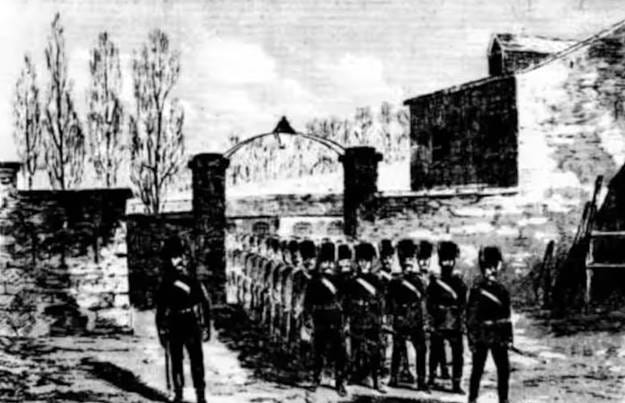
The action sent a chill through society and was written up in the United States as an example of British cruelty and injustice, but the American government did not protest. In discreet recognition of their loyalty, John Black was awarded 53,000 acres in Dorset Township, William Barnard, 40,200 acres in Brompton, and Elmer Cushing 58,692 acres in Shipton Township, all three in the Eastern Townships. Today, Shipton is a part of Danville.
The records show that Black and Barnard participated in the arrest and condemnation of David Mc’Lane, but Cushing was the one who came forward to denounce him, and in doing so Cushing started something that he spent the next almost thirty years desperately trying to justify to himself. His biggest mistake might simply have been that he started a process that went way beyond his expectations and control. He unwittingly supplied the British governing elite with a perfect man to make an example of, to scare the public into line.
Twenty-nine years after the event, Elmer Cushing felt the need to publicly explain what had happened. The document exists still, under the title An appeal, addressed to a candid public and to the feelings of those whose upright sentiments and discerning minds, enable them to “Weigh it in the balance of the sanctuary.”
The long title is followed with a plea to be exonerated
TO a candid Public I address this ‘‘Appeal,” not doubting but they will do me justice as soon as they possess data sufficient to form an opinion. I rest with confidence on the evidence, which I shall here exhibit, for a final decision concerning the rectitude of my moral conduct thro’ life generally, and more particularly concerning my transactions as a witness in the cause of David M’Lane (sic), in the year 1797, who was then tried for high treason, convicted and executed.
It is with no small degree of pain and mortification that I find myself driven to the alternative of making this appeal. – I thereby feel myself, in some measure, degraded from that proud station, to which innocence and unsullied conduct ever entitle us. We have a just claim, without question, to an untarnished reputation, until: some proof or at least some colour of suspicion of improper conduct, should exist against us. I am forced to make my defence against the envenomed tongue of slander—against accusations which are unsupported by one suspicious event—one colour of evidence—Yet, no other resource presenting itself to my view, I here offer my unvarnished tale to the candid, the feeling and sensible part of my brethren of the human family ; fully persuaded that they will do justice to the subject. Fully persuaded that they will try the various instances of my proceedings by the feelings of their own heart, and, by that criterion, determine whether I merit the approbation or frowns of the virtuous part of society
From there he retells the story over 90 pages and the only message that I can take from it is that of a devastated soul. According to his records, he seems to have been continually beaten down for the actions he took, blamed for accepting the reward, and harassed by the ‘Gentlemen of the City,’ who squeezed him for the money he owed them until he had nothing left. History shows, though, that he overcame all of these challenges. He is credited with bringing the first mills to Shipton and he served in important posts. He never seems to have been a happy person, but he did contribute to the creation of a community and should be remembered for his successes.
Elmer and Job Cushing began to work together on the Shipton project, the huge parcel that should have been enough for themselves and their progeny. Job left it to Elmer, to whom it had been awarded, and moved to Trois Rivières where he lived comfortably and raised a family. It is possible that with Elmer’s debts to the Gentlemen of the City there was no room left for Job. Job’s elder son Hezekiel established himself as a successful farmer in Rigaud and his younger son Lemuel’s fortunes rose in Chatham, on the Ottawa River west of Lachute. Both had put Shipton behind them and moved forward. Elmer Cushing died in Stanstead, Quebec in 1835. He was sixty-seven.
When Lemuel Cushing acquired the right to have a post office called Chatham East in his store in 1841, he was 35 years old, and he and Catherine Hutchins, originally of Lachute, had yet to celebrate their 5th wedding anniversary. Eventually they would have 13 children, including five daughters and eight sons. He stayed on as postmaster until 1854 and without him, the post office closed. It was James Brock Cushing who took over the position of postman in 1860. If he were their oldest child, he would have been 23 years old. He next succeeded in becoming the postmaster, reopening the post office in 1864, at which time it became Cushing Post Office. He remained the postmaster until 1893 and the hamlet that had grown around it became commonly known as Cushing.
Well now…,quite the historical snippet! Interesting to note how fragile society was after the British took over governing Quebec…the threat of an American/France collaboration. I may use Elmer Cushing’s apology style next time I need one ! Very eloquent! Thanks for this…well done 👍.B