

Wright’s Rafts

As mentioned last week, Philomen Wright’s plan was to set up an agricultural community. He envisioned farms, but mostly he grew debts. From 1819, as land agent for the Crown, he was accused of corruption and unfair practices, and while it is clear he abused his powers, his behaviour would have to be judged as desperate, given the huge debt he was acquiring to maintain his operations. Nothing would interfere with his vision of a healthy agricultural community, even the absence of money. An ambitious optimist, he teetered on the verge of bankruptcy, and as his sons grew, they learned to play a balancing act to keep his empire safe. In spite of his agricultural priorities, market forces drove his operations, and lumber was the readiest source of cash.
Philomen Wright and Jedediah Lane in the Algonquin Forest

Philemon Wright, the founder of the town that would become Hull (now Gatineau), came north for a business opportunity around the same time as Jedediah Lane acquired the land that would become Lachute from Patrick Murray, the seigneur of Argenteuil. Murray needed cash and he gave up his seigneurial rights on this parcel. Philomen Wright differed in some …
The British navy, at war with Napoleon, paid well for lumber. Starting with over 600 warships in 1792, their losses were phenomenal. They needed the white pine for masts and spars, and the hulls of their warships were made of oak, also available from the ancient Algonquin forests. A heavier wood, it needed to be carried downriver by the more buoyant pine. Wright and his sons learned to float rafts of wood down the Ottawa River to the mighty St. Lawrence and on to Quebec City right from the beginning of that war-driven lumber boom, acquiring most of the lumber from other landowners. In so doing, he no doubt helped them establish prosperous farms, but in time, as their wood ran out, he began to harvest his own vast holdings. He also owned and controlled industries including brickworks, cement manufacture and even a mining company. He built chutes along the river and eventually he partnered in the building of a steamship, the Union of Ottawa, to control his huge lumber rafts.
Lumber was tied into cribs of 20 logs, round in the early days, but eventually squared, and the cribs were then assembled into rafts that could join as many as seventy cribs. Their crew could be 35 to 60 men, depending on the size of the raft, and included cabins, cookhouses, sails and steering oars. When arriving at the rapids, the cribs would be separated and run down individually over rapids or, once they were built, through the chutes. They were reassembled below. Living on a raft became a way of life, as it floated slowly under the power of the currents to Quebec City. Sails and the steering oars could only serve to urge or cajole the large, floating islands this way or that and with enough planning, it was usually possible to tie up to the shore or to the long docks that would be built for them.
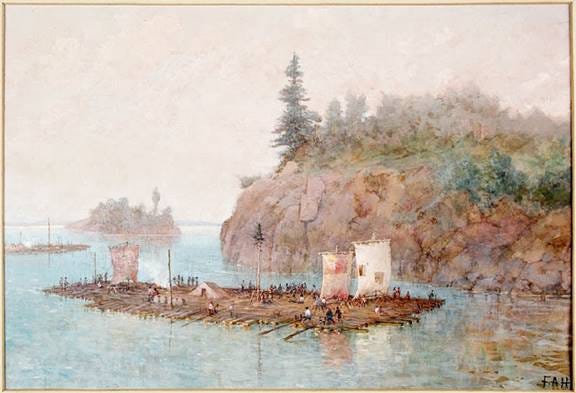
Ruggles and Tiberius, Philemon’s two sons, were early captains of these large, unwieldy craft, but Philemon himself captained the very first one, dubbed the Columbo, in 1806. It consisted of 700 logs and 9000 boards along with thousands of staves, those oak planks that would eventually be curved into shape for shipbuilding. His were white oak and he set them on the cribs of logs. Trying to float them would have been difficult, since they were not buoyant and may have dragged too deeply in the water. The staves were his guaranteed cash product, and he had negotiated a good price should he be able to deliver before the end of July of that first year.
He set off on June 11, floating 20 cribs, each about 24 feet wide, and a crew of five that included his son Tiberius – the first logging raft to attempt the Ottawa. They broke the cribs apart at Long Sault and again at Carillon, losing one crib in the process of floating them through the rapids. The cribs had to be reassembled afterwards, and Wright’s judgment was that the missing crib would have to be replaced. Historians don’t know whether this was a sign of Wright’s extravagant pride or whether it was really necessary for the stability of the raft, but it caused delays. Next, he chose Rivière des Prairies to avoid the Lachine rapids and once he won his way into the St. Lawrence he discovered that his craft could not withstand the strong currents, causing further delays and hardships.
He failed to respect the contract, arriving on August 12, and it took him until the end of November to sell his lumber to new buyers. After that, he took the long journey home through the early winter countryside.
Years later, a large raft Ruggles captained – there were up to 8 a year – just about took out the British Merchant Marine stationed at Quebec as it caught an outgoing tide, hurling past the port. It turned around on the incoming tide and had a second run at the fleet, the whole incident caricaturing the chaotic management of the Wright family as they pioneered this new, cumbersome delivery technique.
Philemon preached the stability of agriculture whenever his finances threatened to topple his empire. He had offered £600 for three-and-a-half townships in 1796 but he was paying £2,000 a year for supplies by 1819. By 1826, he had committed to a mortgage of £12,000 just to secure a part of his debt. The bucolic life of the farmer carried great appeal to Wright and his sons, and they did maintain their farming operations, even introducing Hereford cattle from England, but their debts grew faster than their crops.
Their adventures were compounded and complicated with the arrival of Colonel John By across the river, and they lost good employees to the interloper. They learned that By was a tough taskmaster when they were contracted to build diversion dams and a bridge for his Rideau Canal project. Having a new presence across the river in Upper Canada also caused jurisdictional problems, and in 1825 the deputy sheriff of Bathurst district seized a raft that Tiberius was captaining. To pull off the seizure, fearing that the Lower Canadians would resist with canon and other arms, they rounded up 50 ‘ruffians’ and armed them with every gun on By’s side of the river, including two the Wrights had left there for safe-keeping. The raft was confiscated, but, while the records refer to bloodshed, Wright and his crew never resorted to their cannon as had been feared. They were never compensated for the raft either.
Wright was elected to the Assembly and held every other important position; he secured the first school in Hull, built roads and even captained the Argenteuil militia, but he never succeeded in achieving financial stability, and his empire was on bankruptcy’s doorstep at the time of his death in 1839. He built Wrightstown, and it was named for him, but he is credited with encouraging the town to adopt its official name from the township of Hull.
These were BIG lives, inspiring